Halal traceability on the shop floor: the evidence you have to be able to produce
Halal traceability is the ability to prove, for every batch leaving the plant, that all materials used were halal and never contacted contaminated substances or equipment. The evidence is not the certificate on the wall. It is the material lot records, process sequence, equipment used, and cleaning history, traceable batch by batch.
A halal certificate is not a one-time document
There is a common misunderstanding once the halal certificate arrives.
The work is assumed to be finished.
But the certificate describes your product. Its composition, its materials, its production process as inspected on the day of the audit.
Products do not leave a plant as concepts.
Batches do. Batch 0417, batch 0418, batch 0419. Each made on a different day, from different material lots, sometimes on different equipment.
The halal claim has to be true for every one of those batches, individually.
The certificate says your product is halal.
What proves a particular batch is halal is its production record.
This is where many plants find the gap. The SJPH documentation is complete and the procedures are properly written. Then an auditor picks a batch number at random and asks for the chain of evidence.
Assembling it takes days, and several people reminding each other what happened.
What an audit actually examines
The Halal Product Assurance System requires a company to control and document its production continuously, not only during the certification audit.
In practice, the examination narrows to four connected questions.
| Question | Evidence requested |
|---|---|
| What materials went in? | The per-batch material list with the lots actually consumed, not the ones planned |
| Where did they come from? | Supplier, lot number, and halal documentation still valid for that lot on the day it was used |
| Where and in what order was it processed? | Equipment used, when it was used, and what ran on that same equipment beforehand |
| How was cross-contamination prevented? | The cleaning procedure run between the two uses, and verification that it happened |
None of these can be answered with a policy document.
Every one of them is a question about what happened, not about what was planned.
The three points where it usually breaks
1. Material substitution that never reaches the record
The planned material lot runs out.
The night shift pulls a replacement from the warehouse so production does not stop.
On quality grounds the replacement is equivalent. Often it genuinely is.
The problem appears when that substitution never reaches the batch record, or arrives as a manual correction the following day.
The batch now carries two versions of the truth. What the plan says, and what actually went into the mixer.
For audit purposes only one counts. It is also the harder one to demonstrate.
The fix is structural rather than a matter of discipline.
The system has to record consumption at the moment material is taken, and refuse ineligible lots before they can be used at all.
2. Cross-contamination through shared equipment
Few plants run a dedicated line per product.
Mixers, tanks, fillers and conveyors are generally shared.
As long as the order of use is controlled and cleaning runs between uses, this is not a problem in itself.
Proving it is the problem.
For a given batch you have to show what ran on that equipment beforehand, and that the required cleaning was performed and verified.
Equipment sequence is the hardest thing to reconstruct after the fact.
A manual log records that cleaning was done. It rarely ties that record to which batch preceded it and which batch followed.
3. Supplier documentation that quietly expires
Halal certificates for raw materials have validity periods.
Suppliers change their source, reformulate, or let a certificate lapse without telling their customers.
If a material’s halal status is only checked at supplier registration, you are relying on information that may no longer hold.
What is needed is a check at the point of consumption.
Is this lot, today, still backed by valid documentation?
Why spreadsheets stop working
Spreadsheets are not a bad tool.
For a single line with ten materials, a spreadsheet can work well for years.
What makes them stop working is not data volume.
It is the gap between when something happens and when it is written down.
Spreadsheets are filled in after the fact. End of shift, sometimes the next morning.
What gets recorded is what someone remembered, or what should have happened. Not what actually happened at 02:40.
For quality purposes that gap is usually tolerable.
For halal purposes it sits exactly on the two things that matter most. Material substitution and equipment sequence are the details most easily lost when recording happens later, and they are the two an auditor most wants to see.
There is a quick way to test your own plant.
Pick a batch number from six months ago at random and ask for its complete chain of evidence.
If it takes more than a few minutes, or requires asking a person, the gap is already visible.
What changes when execution is recorded in a system
A Manufacturing Execution System does not make a plant halal.
What it does is move recording from after the process to during it.
It also turns several rules from guidance into something the system actually enforces.
- Material consumption is recorded as it happens. The operator selects the lot on screen, and that lot is what enters the batch record. Substitution stays possible when production genuinely requires it, but it is recorded as a substitution, with who and when.
- Ineligible lots are blocked before use. Expired or held material cannot be consumed, because the system refuses it at the point of picking. That is the difference between preventing and discovering.
- Equipment history builds itself. Every production step is recorded together with its equipment, so the order of use never has to be reconstructed. It is already a consequence of how the data was formed.
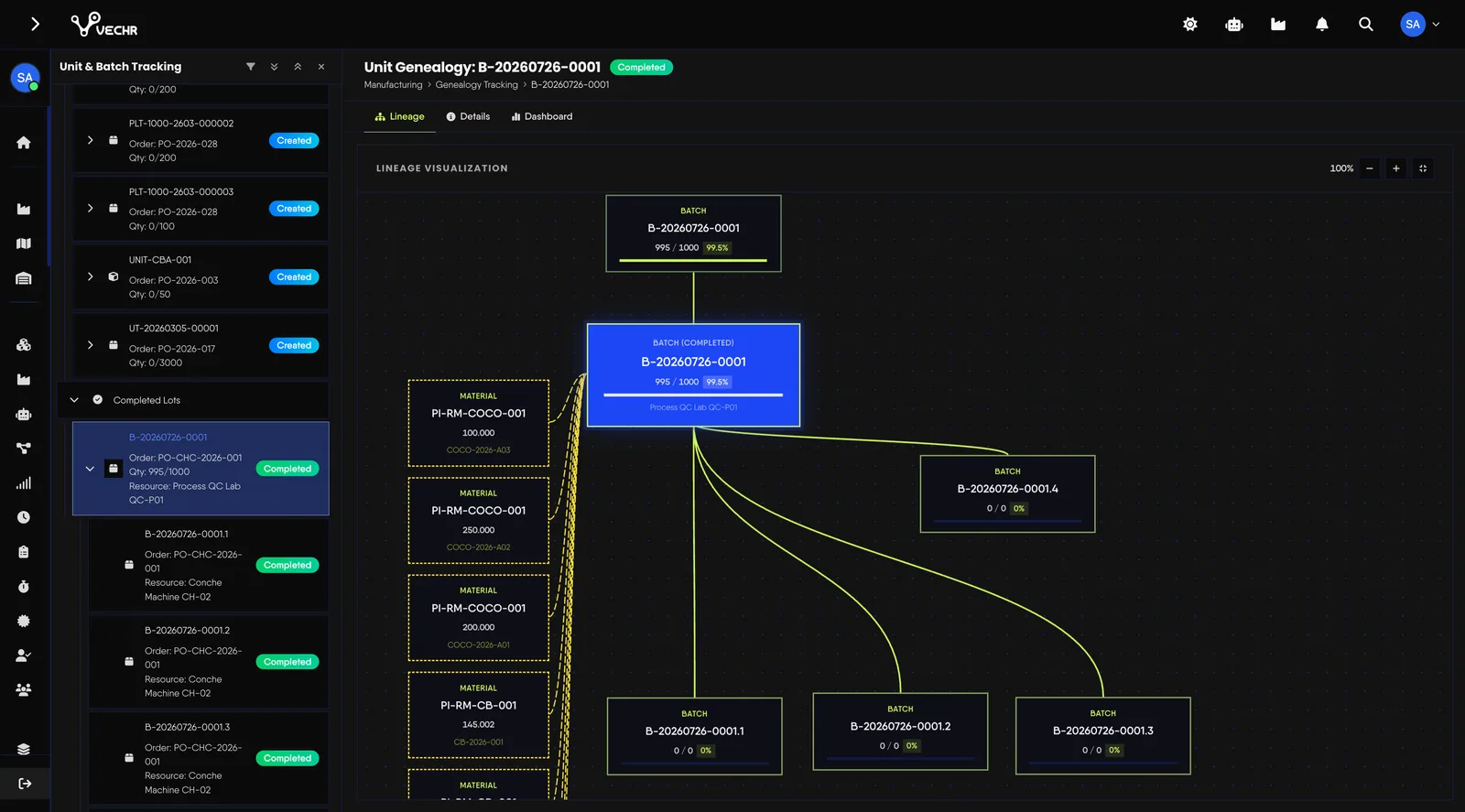
- Genealogy runs both directions. From one material lot forward to every batch that consumed it, and from a batch backward to every lot that formed it, including through splits and merges.
That last point decides how bad a problem becomes.
When a material lot turns out to be non-compliant, the question is always the same. Which batches are affected?
If the lot-to-batch link was captured at consumption, the system answers it.
If it was not, the recall has to widen to a boundary you can actually defend. That boundary is almost always far larger than the true one.
A note on the regulation
Indonesia’s halal product assurance framework is established by Law No. 33 of 2014 and its implementing regulations.
BPJPH issues halal certificates. An LPH performs the inspection. The halal determination for a product is issued through MUI.
The certification obligation has been applied in phases by product category.
Technical requirements and per-category deadlines change, and the phasing differs between large enterprises and micro and small businesses.
For the obligations that currently apply to your product category, consult BPJPH’s official provisions directly.
This article covers the traceability mechanics. It is not a substitute for compliance advice.
What does not change is the principle underneath. The halal claim has to be provable batch by batch, and that proof is formed on the shop floor while the batch is being made.
Where VECHR MES fits
VECHR MES records production execution as it happens rather than afterwards.
Material consumption is captured at the point of picking under system-enforced FEFO or FIFO rules. Expired or held lots are refused before they can be consumed.
Every production step is recorded with its equipment, operator and timestamp. Equipment sequence emerges as a consequence, rather than as something assembled at audit time.
Genealogy is traceable in both directions, from material lot to finished batch and back, including across splits and merges.
Equipment maintenance and cleaning history live in the same system. The relationship between a batch, its equipment, and the work done in between can be read without joining several separate records.
For plants also bound by electronic-records requirements, VECHR MES production records are hash-chained and independently verifiable. The same mechanism is covered in 21 CFR Part 11 for manufacturers.
Frequently Asked Questions
What is the difference between halal certification and halal traceability?
Certification is the process of obtaining recognition from BPJPH for a given product, based on inspection by an LPH and a halal determination from MUI. Halal traceability is the ability to prove that each batch produced after the certificate is issued still meets the same conditions. The certificate says your product is halal. Traceability is what proves batch 0417 is halal too.
Does SJPH require particular software?
No. The Halal Product Assurance System governs what must be controlled and documented, not which software you use. A small plant with one line and a short bill of materials can manage it on paper. The need for a system appears when the number of materials, suppliers and product variants makes manual tracing unreliable rather than merely tedious.
How do you handle equipment shared between different products?
Two things have to be provable. The order in which that equipment was used, and that the required cleaning procedure ran and was verified between the two uses. Without a reliable record of sequence you cannot show the cleaning happened at the right moment. Sequence is also the single hardest thing to reconstruct from manual records after the fact.
What happens if a material turns out to be a problem after production has run?
You need to answer two questions quickly. Which batches consumed that lot, and where those batches were shipped. If the lot-to-batch link was recorded as consumption happened, the system produces the answer. If it was not, the recall scope usually has to be widened well past what was actually affected, because the true boundary cannot be demonstrated.
Is halal traceability different from ordinary traceability?
The mechanics are the same. Lots, batches, genealogy, equipment history. What differs is the status. In ordinary traceability, a wrong material creates a quality problem that can be assessed case by case. In a halal context, one non-compliant material or one contamination event voids the halal claim for that batch, whether or not the product is otherwise perfectly good.