What is an MES? A plain-language guide for manufacturers
A Manufacturing Execution System (MES) is software that connects your ERP to the real activity on the shop floor. It turns the production plan into a process operators and machines can actually run, records what really happened at every step, and reports the actual result back up to the systems above it. Nobody has to rely on a phone call, a chat group, a spreadsheet, or a manual report just to find out where production stands.
The problem first, the acronym later
In many plants, two versions of the truth run side by side. They do not always agree.
The first is the plan. It lives in the ERP: what to make, how much, and when it is due.
It looks tidy and structured. In the end it is still a plan.
The second is reality on the shop floor.
It lives on the whiteboard by the line, in the shift-handover spreadsheet, in the WhatsApp group, and in the heads of the people running the process.
That is usually where it is recorded that the mixer went down at 02:40, or that batch 0417 is still sitting in a holding tank.
One simple question reveals how wide the gap is. When someone asks, “where is this order right now?”, can the answer be read straight off a screen? Or does somebody still have to walk to the floor to check?
This gap between plan and reality is more than an inconvenience.
The impact shows up directly: late deliveries, quality problems discovered a shift too late, and decisions made on data that no longer describes the real situation.
So what is an MES?
There is a category of software built specifically to bridge that gap. The name may still be unfamiliar outside manufacturing, but the role matters.
MES stands for Manufacturing Execution System.
It sits between the planning systems above and the equipment on the floor below, with three main roles:
-
Turning the plan into a process that can be executed. A production order is translated into clearly defined steps. Each step carries its qualified equipment, its required materials, its work instructions, and its quality checks.
-
Recording what actually happened. Every production step, material consumption, measurement, deviation, and electronic signature is captured while the process is running. Nothing is reconstructed from memory or from a report at the end of the shift.
-
Carrying the real conditions back up. The ERP, the dashboards, the supervisor, and anyone else who needs production status all see the same information, based on actual data from the shop floor.
If ERP is the trip plan, MES is what shows you where you are right now.
ERP tells you where you need to go. MES shows you what is happening along the way.
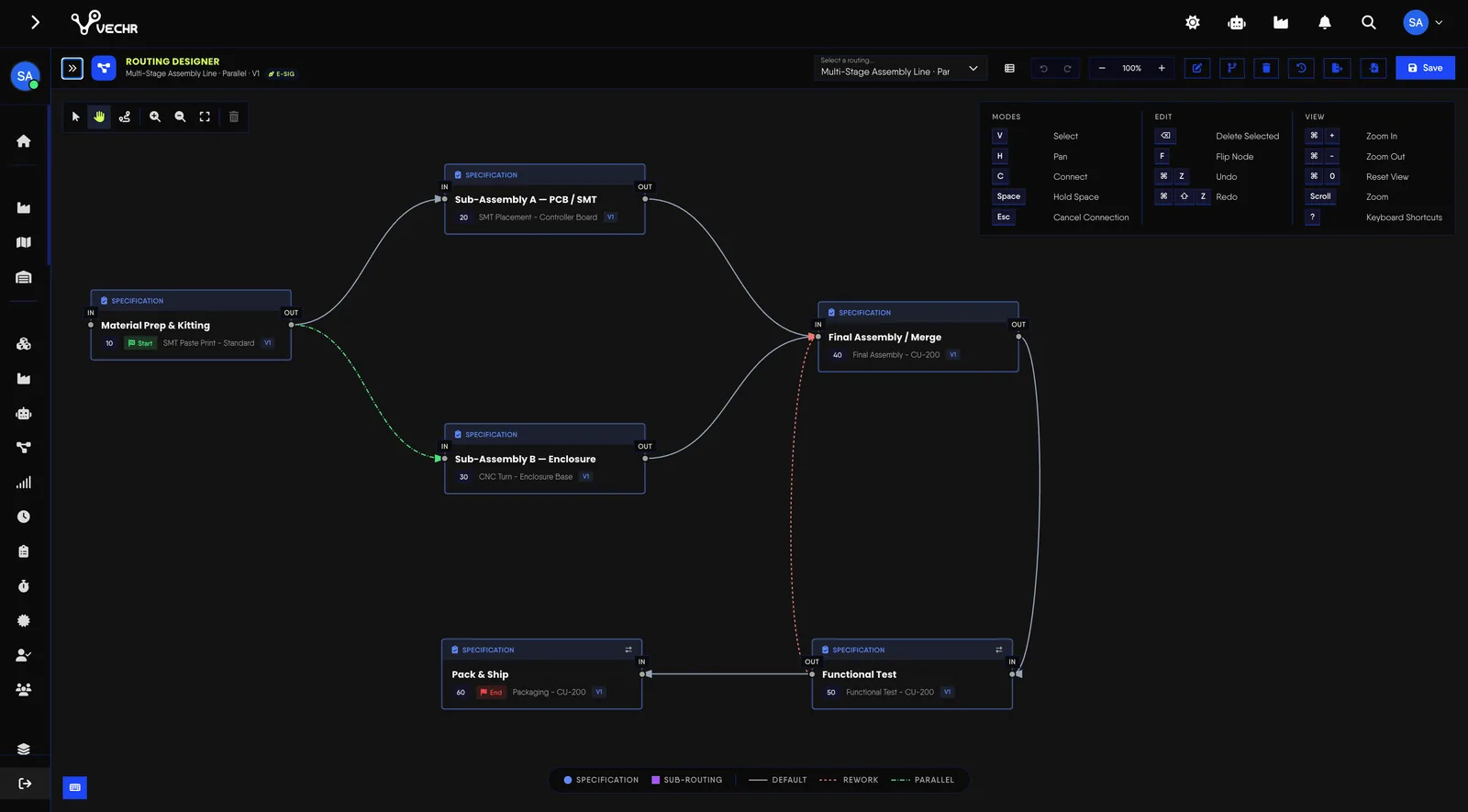
What an MES does day to day
The definition is easy enough to follow. What matters more is what the system actually does on the shop floor.
In practice, a complete MES helps manage six main areas:
| Area | What it means on the floor |
|---|---|
| Production execution | Operators run and complete each production step directly in the system. Timestamps, equipment, and operator identity are captured automatically. |
| Material management | The system helps determine which material lot should be used according to rules such as FEFO or FIFO, and prevents expired material from being consumed in production. |
| Quality management | An out-of-spec measurement can raise a non-conformance immediately and put the affected unit on hold, instead of waiting for the problem to be noticed later. |
| Maintenance management | Preventive maintenance can be scheduled by calendar date or by running hours. Work can also be controlled so that required spare parts are genuinely consumed before maintenance is closed out. |
| Traceability and genealogy | Any batch, serial, or lot can be traced forward to where the material went and backward to where it came from, including through splits and merges. |
| Equipment performance | Live data from the equipment feeds availability, performance, and quality continuously, rather than being collected by hand into a spreadsheet at the end of the period. |
In other words, an MES is not just somewhere to record production.
It connects people, materials, process, quality, maintenance, and equipment into one execution flow that can be monitored and traced.
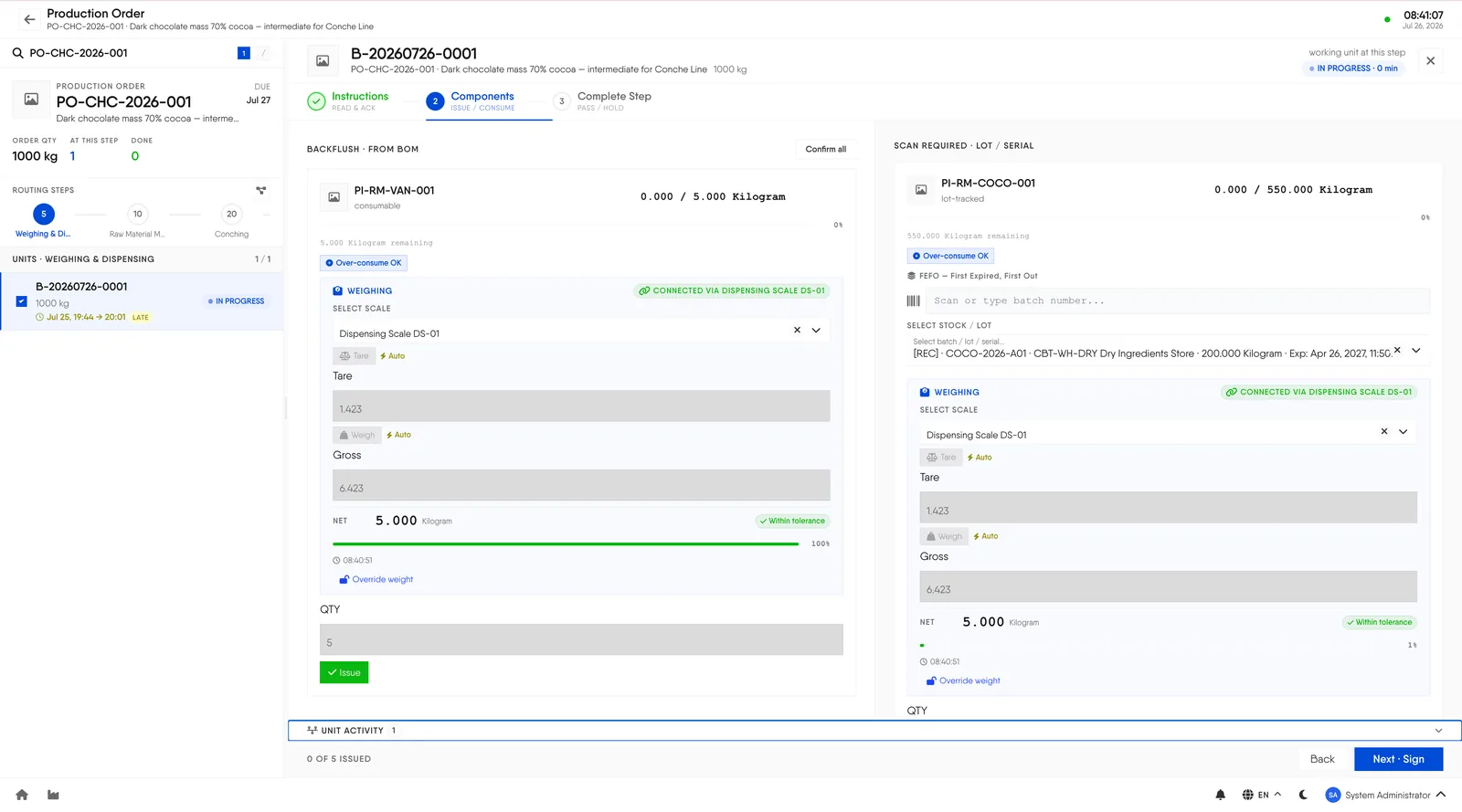
What an MES is not
- Not an ERP replacement. Production planning, purchasing, finance, and other business processes stay in the ERP. The MES takes the execution layer underneath.
- Not a SCADA system. SCADA focuses on monitoring and controlling equipment in real time. An MES uses that data in a wider context: production orders, materials, lots, and operators.
- Not just a reporting tool. An MES does not merely gather data to be turned into reports after the fact. The data should be captured as the activity happens, so reports are built from real events rather than from whatever someone managed to write down or remember afterwards.
How to tell your plant is starting to need one
It is probably time to consider an MES if more than two of these feel familiar:
- Answering “where is this order right now?” still means phoning someone or checking on the floor in person.
- During an audit or a recall, traceability still depends on finding the right binder, spreadsheet, or file.
- Quality problems are discovered at the end of the run, not at the step that caused them.
- Two people can consume the same material lot because the stock figure has not been updated in real time.
- Your OEE number is still calculated and tidied up by hand, and even the person who produced it is not entirely confident in it.
- Preventive maintenance slips because equipment running hours are not connected to the maintenance schedule.
None of that is unusual.
It is what typically happens when the production plan and the activity on the floor live in different systems.
And that is where an MES starts to earn its place: connecting the two, so that what was planned and what actually happened can be read from the same source of data.
Where VECHR MES fits
VECHR MES is Manufacturing Execution System (MES) software built to bridge the gap between the production plan and what actually happens on the shop floor.
You do not have to replace the systems and equipment you already run.
VECHR connects upward to ERP and downward to shop-floor equipment over OPC UA, MQTT, and Modbus TCP. The PLCs, sensors, and machines already in place can send data straight into the MES, provided they support one of those protocols.
The six main areas above are all covered on one platform: production execution, materials, quality, maintenance, traceability, and equipment performance.
VECHR MES is designed to support a range of manufacturing types. That covers discrete manufacturing such as assembly, electronics, and automotive components, and process manufacturing such as food and beverage, chemicals, and tank-and-batch production.
Frequently Asked Questions
Do we still need an MES if we already have an ERP?
It depends on what your plant needs. An ERP manages planning, orders, materials, and business processes at company level. What it usually does not handle is the detail of what is happening on the floor moment to moment: which machine a batch is on, which operator ran the last step, or which lot of raw material actually went into it. An MES fills that in by recording and managing production execution directly.
Is an MES only suitable for large factories?
No. The assumption comes from enterprise MES platforms, which usually require large, complex, time-consuming implementations. But an MES does not have to work that way. A right-sized platform can start with a single plant or a handful of production lines and grow as the plant needs it to.
Do we have to replace our existing machines or SCADA?
No. An MES should work with the equipment and systems you already have, as long as it supports their communication protocols. VECHR MES supports OPC UA, MQTT, and Modbus TCP, so equipment using those protocols can be connected without replacing machines or the SCADA system already running.
How is an MES different from a spreadsheet or a whiteboard?
Spreadsheets and whiteboards depend on what someone got around to writing down. An MES records production activity as the process actually happens, complete with a timestamp, user identity, material, equipment, and process context. The difference is not simply digital versus manual. It is the difference between a note made afterwards and data captured directly from the process.