Quality that is recorded, acted on, and ready to trace
Quality management is more than recording inspection results. When a deviation occurs, the system can raise a non-conformance, hold the affected unit, and keep the entire history in a record that can be verified.
Out of spec raises a non-conformance and holds the unit. Every batch traces forward or backward, and every signature can be verified.
Today Deviations are caught at the weekly meeting.
With VECHR MES Out of spec triggers a non-conformance and an automatic hold.
Today A recall means days of digging.
With VECHR MES Genealogy traces any batch forward or backward in seconds.
Today Records can be edited without a trace.
With VECHR MES Hash-chained signatures make any change visible.
What quality and traceability cover
- Non-Conformance Management Record deviations in real time, from operator input or automatically when a measurement falls outside specification. Every non-conformance follows an Open → Investigation → Disposition → Closed flow, with auto-hold based on severity.
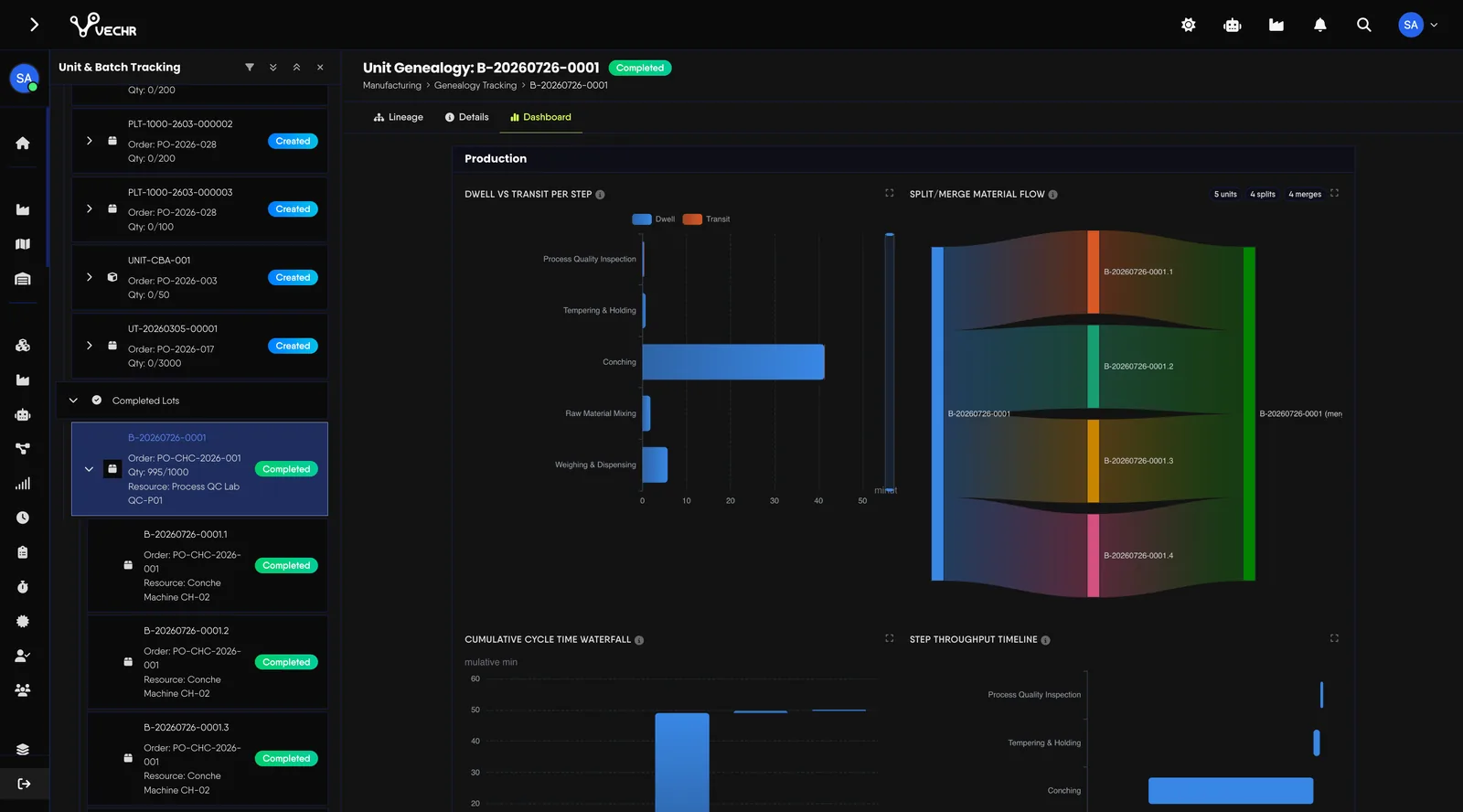
- End-to-end genealogy and traceability Trace a product backward to its raw material lots and forward to its final product or destination. Splits and merges stay recorded, including the comparison between the material that should have been used and what was actually consumed.
- Rule-based production transactions Every activity (move, consume, scrap, rework, hold/release, split, merge) runs under the rules of the process. Where an exception arises, an override still requires a reason and is recorded in the audit trail.
- Real-time inventory control The inventory ledger updates at lot and location level as transactions happen. The system supports FIFO (First In, First Out), FEFO (First Expired, First Out), or manual allocation, QA quarantine controls, and blocks the use of expired or non-compliant stock.
- Batch and unit records ready for audit An EBR (Electronic Batch Record) summarises the material, process, and signature history for a batch. An EDHR (Electronic Device History Record) gives the same level of detail for a single unit, while a generic report covers any production view or time range. Every document is hashed at generation, so the export can be verified.
Non-conformances follow a clear flow
Every deviation has a clear process from start to finish. Only the legal next states are offered, and every status change is recorded.
| Stage | What happens |
|---|---|
| Open | Recorded by an operator, or created automatically when a data collection result falls outside specification. |
| Under review | The team triages severity, the non-conformance code, and the affected units. |
| Investigation | The root cause is traced and supporting evidence is recorded on the same record. |
| Disposition | Decide the action: use as-is, rework, reprocess, scrap or reject. The deciding user and the time are recorded. |
| Closed | The non-conformance is closed, and its entire history remains in the audit trail. |
A minor non-conformance can skip straight to Disposition. Non-conformance codes sit in a tree of groups that can be scoped per plant.
Auto-hold when the system finds a problem
- Out-of-specification results raise an NC automatically When a data collection result falls outside its defined limits, the system can raise a non-conformance without waiting for an operator to notice it first.
- Critical severity holds the unit immediately The affected batch or lot cannot continue through the process until the hold has been handled according to procedure.
- Expired stock cannot be consumed Expired lots are blocked from consumption. If an operator chooses a lot outside the FEFO or FIFO recommendation, the reason must be recorded.
Evidence that can be verified independently
- Hash-chained signatures Every signature is cryptographically linked to the record before it, so a change to an older record can be detected through the hash chain.
- The audit trail is append-only The audit trail provides no edit or delete path, administrators included. Append-only is part of the system design, not a permission that can be changed.
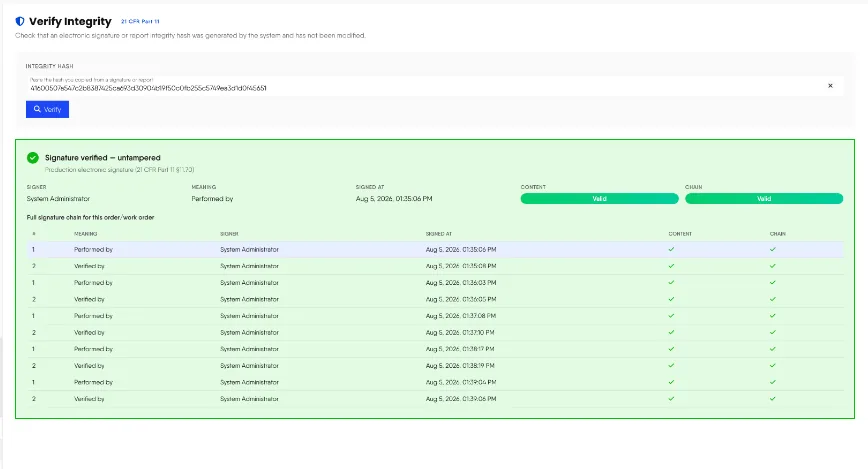
- Verification without a login Exported documents carry a hash that a third party can use to check the document's integrity without holding an account on the system.
- EBR and EDHR ready to export Material, process, and signature history can be exported as documents carrying their integrity information, so the result stays verifiable after it is printed or shared.
Electronic signatures where the process demands them
A Signature Meaning states what a signature means. A Signature Requirement sets how many signatures are needed, and from whom, in one or more slots.
| Attached to | What it gates |
|---|---|
| A step (Specification) | Move Out of that step, enforced on the server. |
| An order (Routing) | Batch release of the order, enforced on the operator screen. |
| A maintenance task | Completion of the work order, with its own signature trail. |
Non-conformance dispositions are not e-signed yet. The deciding user and the time are recorded instead.
The Unit Tracking Report tells the whole story of one unit
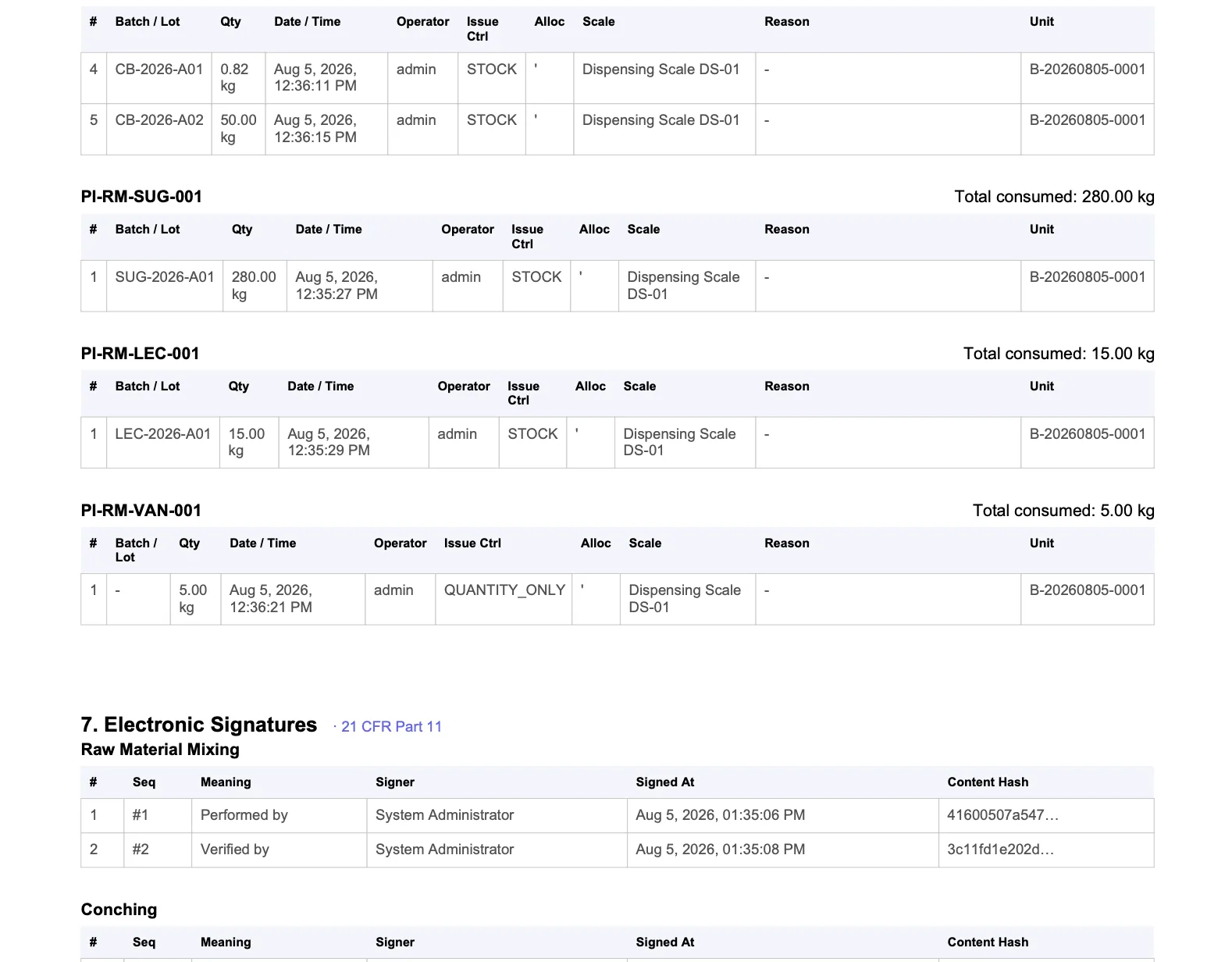
One report brings together everything recorded about a unit. It exports as a signed, tamper-evident batch record.
- Identity and journey Headline figures, a flow timeline, the routing journey with step durations, and a breakdown by transaction.
- Material and quality Material consumption net of returns and scrap, data collection results with each revisit as its own pass, quality metrics and non-conformance records.
- Instructions and signatures Work-instruction acknowledgements and electronic signatures, in the order they happened.
- Packaging Quantities in every alternative unit, the order as placed, catch-weight against nominal, and every pallet with its SSCC (Serial Shipping Container Code), voided ones with their reason.
- Checked by Verify Integrity The export carries an integrity hash. The Verify Integrity screen recomputes it, so any change to the document is detected.
Frequently Asked Questions
What QA and compliance teams usually want settled first.
Does an operator have to notice the deviation first?
No. If a data collection result falls outside specification, the system can raise a non-conformance automatically. At critical severity, the affected unit goes on hold immediately.
Can an administrator edit or delete the audit trail?
No. The audit trail is designed append-only, so it provides no edit or delete path. That is part of the system design, not a permission that can be reconfigured.
How far back can a lot be traced?
From the finished product back to the raw material lots used, including through splits and merges, and then forward again to the destinations or units that consumed that material.