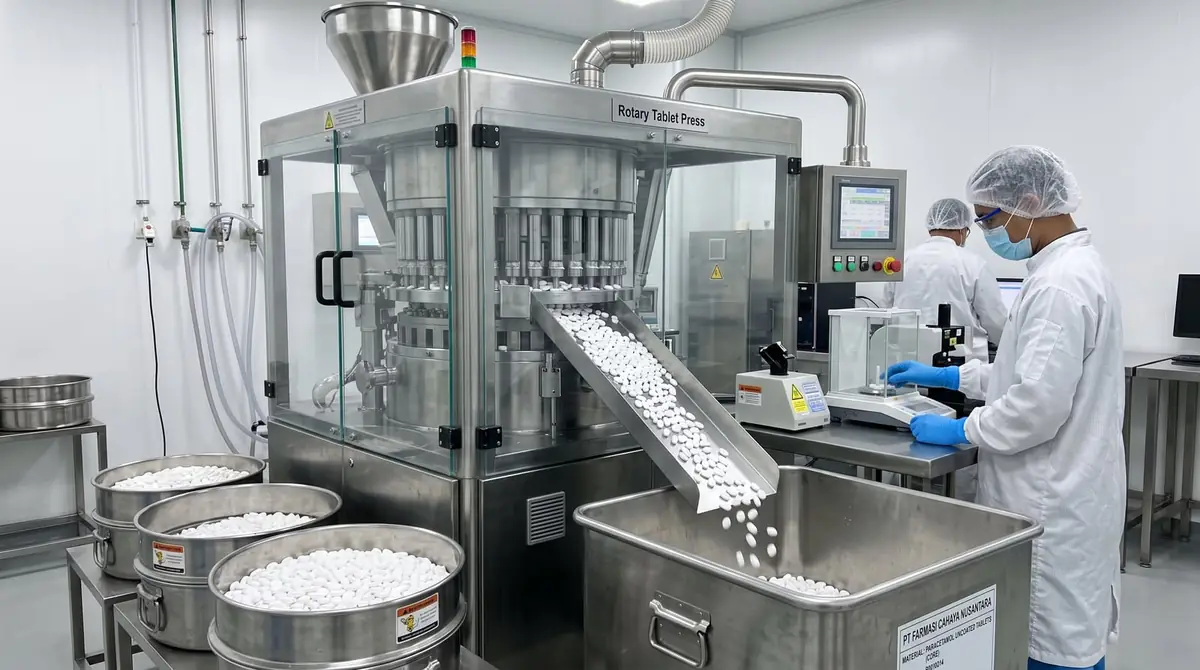
Dispensing to QA release, with every signature where it belongs.
A solid-dose plant lives by its batch record. VECHR MES enforces it at each step, so the record is complete the moment the batch ends.
Only released material can be consumed. Weighing needs a second person's signature. IPC values come from the tester. Signatures are re-authenticated and hash-chained, built on 21 CFR Part 11 principles.
Worked example: 360 kg of blend becomes 600,000 tablets, then 5,900 boxes on 4 pallets.
- 360 kg of final blend
- 600,000 tablets compressed
- 5,900 boxes on 4 pallets, released by two signatures
- Product
- Paracetamol 500 mg film-coated tablet, box of 10 × 10 (fictional)
- Bulk order
- 600,000 tablets, 370.8 kg, one batch number for bulk and pack
- Pack order
- 6,000 boxes, 5,900 packed on 4 pallets, 28 boxes to QC (Quality Control) samples
- Yield
- Bulk 99.1 %, packing 98.3 %
- Machines
- Scales, granulator, dryer, tablet press and tester, coater, blister lines, checkweigher
SAP owns stock and material status. VECHR MES consumes only lots SAP QM has released, posts receipts into quality-inspection stock, and gets the released bulk back as stock for packing.
Nine stages, one batch record.
From the dispensing booth to QA (Quality Assurance) release. Scroll to follow the batch.
-
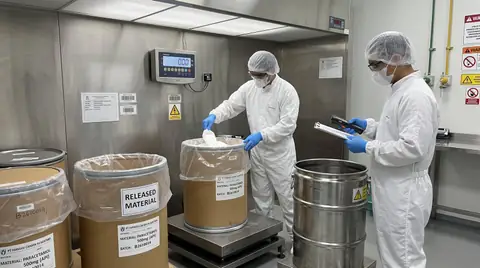 01 kg Dispensing VECHR MES records Released lots only. Weighed by and verified by.
-
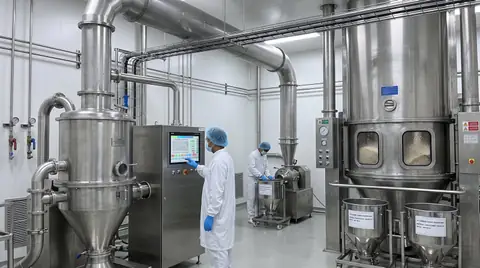 02 batch Granulation and drying VECHR MES records End point and LOD from the PLC
-
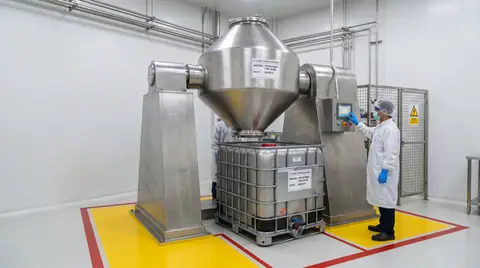 03 batch Final blend VECHR MES records Lubrication time
-
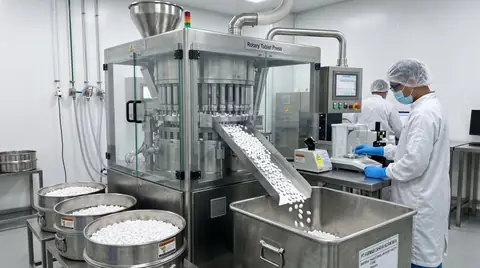 04 tablets Compression VECHR MES records IPC every 30 minutes: weight, hardness
-
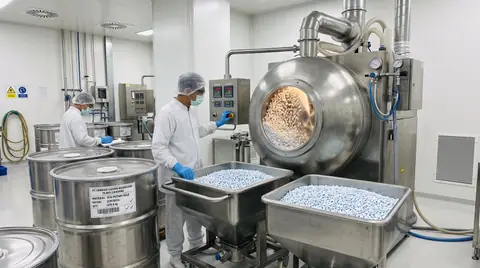 05 tablets Film coating VECHR MES records Bed temperature and weight gain
-
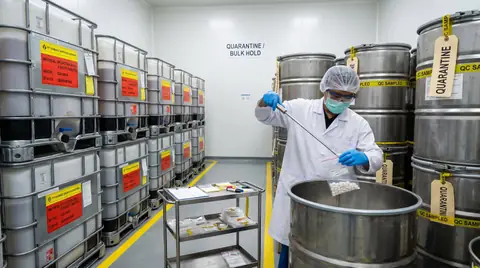 06 bulk lot Bulk hold and QC VECHR MES records Validated hold time enforced
- Bulk becomes packs
-
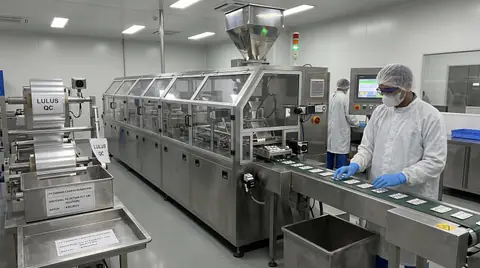 07 blisters Primary packing VECHR MES records Line clearance, coder text read back
-
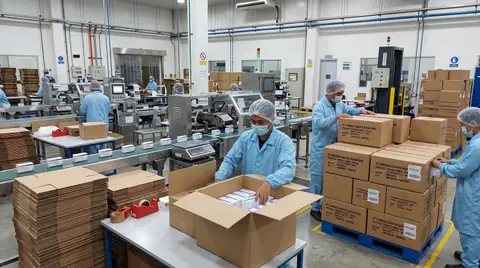 08 boxes · pallets Secondary packing VECHR MES records SSCC per pallet
-
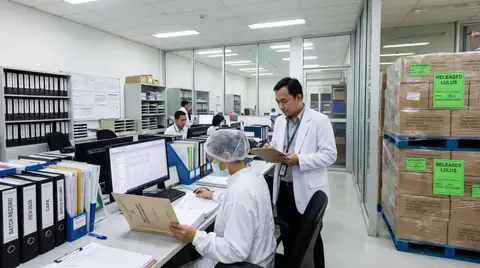 09 batch QA release VECHR MES records Record review, two-person signature
Who decides what, and where it shows up.
| Record | Owned by | What the other side does |
|---|---|---|
| Incoming material released, rejected or due for retest | SAP QM | Stock status in VECHR MES, enforced at dispensing |
| Bulk released for packing | SAP QM | Released bulk stock sent to VECHR MES |
| Batch held on the floor | VECHR MES | Block in SAP, if already received |
| Finished goods released | VECHR MES, two signatures | Usage decision in SAP |
| Lab results and deviations | LIMS and QMS | Results into the batch record, deviations raised on the floor |
Released material, a second person's signature and machine-read IPC, enforced at each step.
Today The second checker signs a paper sheet later.
With VECHR MES Weighed by and Verified by sign at the step, from their own logins.
Today IPC (In-Process Control) values are written down every 30 minutes.
With VECHR MES Values come from the tester and press, locked, with limits enforced.
Today A quarantined lot slips into dispensing.
With VECHR MES Only unrestricted lots can be consumed. Everything else is refused.
Today The batch record is assembled after the batch.
With VECHR MES It is complete when the batch ends, ready for review.
How to read the status: Ready runs on the standard product. Configured is assembled in your project from existing building blocks, without new code. Built on request is developed once discovery confirms the need.
| Stage | How VECHR MES handles it | Status |
|---|---|---|
| Material status | Expired lots and anything not released are refused. FEFO (First Expired, First Out), with a stored reason for an override. | Ready |
| Dispensing | Tare and gross from the scale, weighing lock, wrong material refused. The tolerance band is shown. | Ready Configured in your project |
| Second-person check | Weighed by and Verified by, different signers, password re-entry. The step cannot finish until both sign. | Ready |
| IPC | Limits enforced by the system, one record per 30-minute check, values read from the tester and press and locked. | Ready |
| Out of limits | Refused, or accepted only with a reason and an automatic non-conformance. | Ready Configured in your project |
| Deviations | Code, severity and lifecycle to disposition. A critical deviation holds the batch. | Ready |
| Bulk hold time | The validated hold time is enforced. The lot is refused after it. | Ready |
| Equipment status | A machine awaiting cleaning cannot take the next batch. | Configured in your project |
| Operator qualification | Certifications with expiry, checked before a step starts. | Configured in your project |
| Line clearance | Work instruction with required steps, acknowledgements, operator and QA signatures, before blistering. | Ready |
| Packaging | Coder text sent and read back, rejects by cause, QC samples, pallets with GS1 SSCC (Serial Shipping Container Code). | Ready |
Seven checks between the dispensing booth and release.
Each one sits on the step it protects, with the signature it needs.
21 CFR Part 11 principles, built into how records are made.
- Password re-entered at every signature, failures logged
- Name, date, time and meaning shown on screen and in the PDF
- A SHA-256 hash chain per order, checked with Verify Integrity
- An append-only audit trail with old and new values
- Account lockout, password expiry and a system access log
- Line clearance as a signed work instruction before packing
21 CFR Part 11 and Annex 11, control by control.
| Control | How VECHR MES handles it | Status |
|---|---|---|
| Signature components (§11.200) | Logged-in user plus password re-entered at every signature, failures logged | Ready |
| Manifestation (§11.50) | Name, date and time, meaning, on screen and in the PDF | Ready |
| Linking (§11.70) | Bound to order, unit and step, SHA-256 chain per order, Verify Integrity | Ready |
| Sequencing and authority (§11.10 f, g) | Routing sequence, signature slot order, role per slot, different-signer rule | Ready |
| Audit trail (§11.10 e) | Master data with old and new values. Transactions append-only, corrections as new records. | Ready |
| Access (§11.10 d, §11.300) | Password complexity and expiry, lockout, idle timeout, system access log | Ready |
| User IDs never reused (§11.100 a) | Unique among active users. Disable, do not delete. | Configured in your project |
| Reason for change, approval of revisions (Annex 11 §9) | Not built yet | Built on request |
| Validation (§11.10 a) | Functional and configuration specs, traceability, IQ and OQ scripts as a services deliverable | Built on request |
Machine values arrive in the batch record without typing.
The Edge Agent reads the equipment and keeps recording if the network drops.
| Machine signal | What happens in VECHR MES | Status |
|---|---|---|
| Granulator end point, dryer and coater temperatures | Values in the batch record, locked | Ready |
| Tablet tester result | A new IPC record every 30 minutes | Configured in your project |
| Press force out of band | Non-conformance raised and batch held | Configured in your project |
| Machine run, stop, fault | Downtime record, with the reason added by the operator | Configured in your project |
| Batch starts at the blister line | Batch and expiry written to the coders, read back | Configured in your project |
| Batch leaves a machine | Machine set to awaiting cleaning | Configured in your project |
The press is the bottleneck. Drum-Buffer-Rope paces the schedule to it, and OEE (Overall Equipment Effectiveness) shows where its time went.
From the API lot to the delivery, in both directions.
The batch record PDF carries every consumption, signature, IPC value, non-conformance and pallet, with an integrity hash.
A recall, step by step.
- 1 Block the suspect lot SAP QM blocks it, and dispensing refuses it at once.
- 2 Find bulk, then FG batches One level per query, in VECHR MES.
- 3 Hold and block Holds in production, finished stock blocked in SAP.
- 4 Pallets to deliveries SSCCs lead to the deliveries in SAP.
- 5 Link it to the QMS One non-conformance per batch, linked to the recall.
Real cases this answers: the 2019 ranitidine withdrawal and the 2022 contaminated-solvent syrup cases, both about raw-material source and quality.
The tablet press sets the pace.
Cleaning sits inside the plan, not after it.
- Drum The bottleneck that limits the whole plant. VECHR MES detects it automatically from the load.
- Buffer How many minutes earlier the steps before the drum start, so it never waits.
- Rope The release rule: upstream work starts at drum free minus buffer. Steps after the drum run forward.
Illustrative timing: the operations before the bottleneck take 45 minutes, and the bottleneck is free at 10:00.
| Need | How it is handled |
|---|---|
| Bottleneck pacing | Drum-Buffer-Rope paces granulation and blending to the press |
| Cleaning between batches | Cleaning time on the resource schedule, and machines blocked while awaiting cleaning |
| Bulk hold | Validated hold time enforced on the bulk lot |
| Changeovers | A changeover matrix per resource, from product to product |
| Capacity | Shifts, calendars, breakdowns and certified crews |
The scheduler adds changeover time for the sequence it builds. Campaign sequencing stays with the planner.
SAP QM decides lot status. VECHR MES enforces it on the floor.
Lot status from SAP controls what can be consumed. Movements and usage decisions go back.
About 25 postings a batch. The effort is in the QM decisions, not the volume.
| SAP movement | Posted when | Status |
|---|---|---|
| Goods issue (261) at dispensing | Each dispensed lot is consumed | Configured in your project |
| Bulk goods receipt (101) into quality stock | Bulk leaves the last process step, opening the QM inspection lot | Configured in your project |
| Released bulk back to packing | SAP QM releases the bulk and stages it | Configured in your project |
| Goods issue (261) at packing | Foil, PVC (Polyvinyl Chloride), leaflets and boxes are consumed | Configured in your project |
| FG goods receipt (101) into quality stock | A pallet is closed | Configured in your project |
| Scrap | Rejects and QC samples are recorded | Configured in your project |
| FG usage decision | QA release is signed | Configured in your project |
Interface rules
- Orders are matched by number before they are created
- SAP dates are planned dates. The BOM (Bill of Materials) is copied at release.
- One batch number for bulk and pack, from SAP or from the numbering pattern
- Expiry is dated from manufacture, sent as SAP's shelf-life date
- Receipts always go into quality-inspection stock
- A staging table with nightly reconciliation, and the flows sit inside the validation scope
44 of 77 typical URS requirements are ready today, including the Part 11 core.
44 ready · 16 configured · 17 on request, out of 77 typical requirements
Ready44
- Order execution, recipe version frozen per order
- Released-lot and expiry checks, FEFO with reason
- Two-person dispensing and line-clearance signatures
- IPC from machines, enforced limits
- Non-conformance, hold, rework, scrap
- Part 11: signatures, hash chain, audit trail, access log
- Batch record PDF, genealogy to pallet
- Two-person release step
- DBR on the press, cleaning in the plan, OEE, maintenance
Configured in your project16
- SAP postings and QM usage decision
- Hold on every IPC failure
- Equipment awaiting-cleaning state
- Operator qualification check
- Yield range check, recall report
- Lab results into the record
- Environmental monitoring by data point
Built on request17
- Hard weighing tolerance, mandatory unlock reason
- Reason for change, signed revision approval
- Equipment logbook, clean and dirty hold times
- Review by exception, archived batch record
- E-signed NC disposition, CAPA (or a QMS)
- Serialisation (BPOM 2D barcode)
- Validation package (services)
Proof of Concept: dispensing, the press and one blister line, 6 to 8 weeks.
One product, against an SAP sandbox.
| Area | Acceptance criterion |
|---|---|
| Material | A quarantined lot is refused at dispensing |
| Dispensing | Every component with weight, lot, scale and two signatures, and the step refused until both sign |
| IPC | 30-minute checks from the tester without typing, and a failure holds the batch |
| Line clearance | Acknowledgements and two signatures before the first blister |
| Batch record | QA reviews a POC batch from the PDF, timed against a paper batch |
| Part 11 | Your QA and CSV (Computer System Validation) team classifies each Part 11 control as product, configuration or procedure |
| SAP | Every posting has a document number the next morning, with zero reconciliation differences |
Decisions we make together in the first workshop.
- Regulators in scope: BPOM (Badan Pengawas Obat dan Makanan) only, or FDA (Food and Drug Administration) and export too
- Validation approach and owner (GAMP 5, IQ, OQ, PQ)
- Where material, bulk and FG release decisions live
- Who owns the batch number and expiry
- Shared terminal or own device for the second signer
- How equipment cleaning and calibration are recorded
What changes, batch by batch.
Illustrative inputs from the worked example. Your own figures replace them in the Workshop Assessment.
| What changes | Today | With VECHR MES |
|---|---|---|
| Unplanned press downtime | 1.0 h a shift | 0.9 h a shift |
| Review, documentation errors and SAP entry | About 13.6 h of manual work a batch | Reviewed on screen, posted by flows |
| Batches lost to a dispensing or record error | 1 in 500 | 1 in 1,000 |
Frequently Asked Questions
Is VECHR MES validated for GMP?
VECHR MES is built on 21 CFR Part 11 principles. Validation for your site is a project deliverable, scoped in the Workshop Assessment.
Does it enforce the second-person check?
Yes. A step can require two signatures from different people, with password re-entry. The batch cannot move on until both have signed.
Does it work with SAP QM or a LIMS?
Yes. Lot status from SAP QM decides what can be consumed, and usage decisions go back. LIMS (Laboratory Information Management System) results arrive through a flow configured in your project.
What about CPOB?
The same controls support what CPOB (Cara Pembuatan Obat yang Baik) expects of electronic records: attributable, tamper-evident and reviewable. Our article on CPOB and electronic systems goes deeper.
Keep reading
- 21 CFR Part 11 for manufacturers: what it demands of your systems What 21 CFR Part 11 requires from electronic records and electronic signatures: attributable, tamper-evident, and independently verifiable. Here is what that looks like concretely in an MES audit trail.
- CPOB and computerised systems: what Indonesian GMP asks of digital production records When batch records move from paper to a system, CPOB demands things paper never had to provide. Here are the ALCOA+ principles, what they mean on the shop floor, and where vendor responsibility ends.
- Electronic batch records: what actually changes when the paper goes An EBR is not a scanned batch record. The value is in refusing bad data at entry and enabling review by exception. Here is what an EBR contains, why review by exception is the real return, and where implementations go wrong.
Terms on this page(35)
- 21 CFR Part 11Title 21 Code of Federal Regulations, Part 11 (US FDA)
- The FDA rule for electronic records and electronic signatures: who did what and when, changes that stay visible, and signatures bound to the record they sign.
- APIActive Pharmaceutical Ingredient
- The ingredient in a medicine that has the therapeutic effect.
- BOMBill of Materials
- The list of materials, and how much of each, needed to make one product.
- BPOMBadan Pengawas Obat dan Makanan
- Indonesia's food and drug regulator. It inspects factories against CPOB.
- CAPACorrective and Preventive Action
- The follow-up to a deviation: fix the cause, then stop it happening again.
- CPOBCara Pembuatan Obat yang Baik
- Indonesia's Good Manufacturing Practice for medicines, enforced by BPOM.
- CSVComputer System Validation
- Documented proof that a computerised system does what it should, for its intended use.
- DBRDrum-Buffer-Rope
- A scheduling method that paces the whole line to its bottleneck (the drum).
- FDAFood and Drug Administration (US)
- The US regulator for food and medicines. It publishes 21 CFR Part 11.
- FEFOFirst Expired, First Out
- Use the material that expires soonest first.
- FGFinished Goods
- The packed product, ready to ship.
- GAMPGood Automated Manufacturing Practice
- ISPE guidance for validating computerised systems by risk and by category.
- GMPGood Manufacturing Practice
- The rules that make sure products are made consistently and to quality standards.
- GS1GS1 standards
- The global body behind product barcodes and identifiers such as GTIN and SSCC.
- IPCIn-Process Control
- Tests taken during production, such as tablet weight or hardness.
- IQInstallation Qualification
- Proof that a system is installed as specified. The first of IQ, OQ and PQ.
- LIMSLaboratory Information Management System
- The lab's own system for samples, tests and results.
- LODLoss on Drying
- A moisture test: weigh, dry, weigh again.
- MESManufacturing Execution System
- The system that runs and records production on the floor: orders, materials, steps, quality and machines.
- MMMaterials Management
- SAP's module for materials, stock and purchasing.
- NCNon-Conformance
- A record that something did not meet its specification, with what happens to it next.
- OEEOverall Equipment Effectiveness
- Availability × performance × quality: how much of the planned time turned into good product.
- OQOperational Qualification
- Proof that a system works as specified across its operating range.
- PLCProgrammable Logic Controller
- The industrial computer that controls a machine and holds its live values.
- PPProduction Planning
- SAP's module for production orders and planning. PP-PI is the process-industry variant.
- PQPerformance Qualification
- Proof that a system performs consistently in real production use.
- PVCPolyvinyl Chloride
- The plastic film blister packs are formed from.
- QAQuality Assurance
- The team that releases product and owns the quality system.
- QCQuality Control
- The team, usually the lab, that tests samples against specification.
- QMQuality Management
- SAP's quality module: inspection lots, results and usage decisions.
- QMSQuality Management System
- The procedures and records a company runs quality by, such as deviations, CAPA and change control.
- SAPSAP ERP
- The ERP most large Indonesian manufacturers run. S/4HANA is its current generation.
- SHA-256Secure Hash Algorithm, 256-bit
- A fingerprint of a record. Change one character and the fingerprint no longer matches.
- SSCCSerial Shipping Container Code
- The 18-digit GS1 number that identifies one pallet or shipping unit.
- URSUser Requirement Specification
- The document that says what the plant needs a system to do. Validation tests against it.
See VECHR MES on your own process.
A walkthrough built around how your plant runs. Not a generic demo.