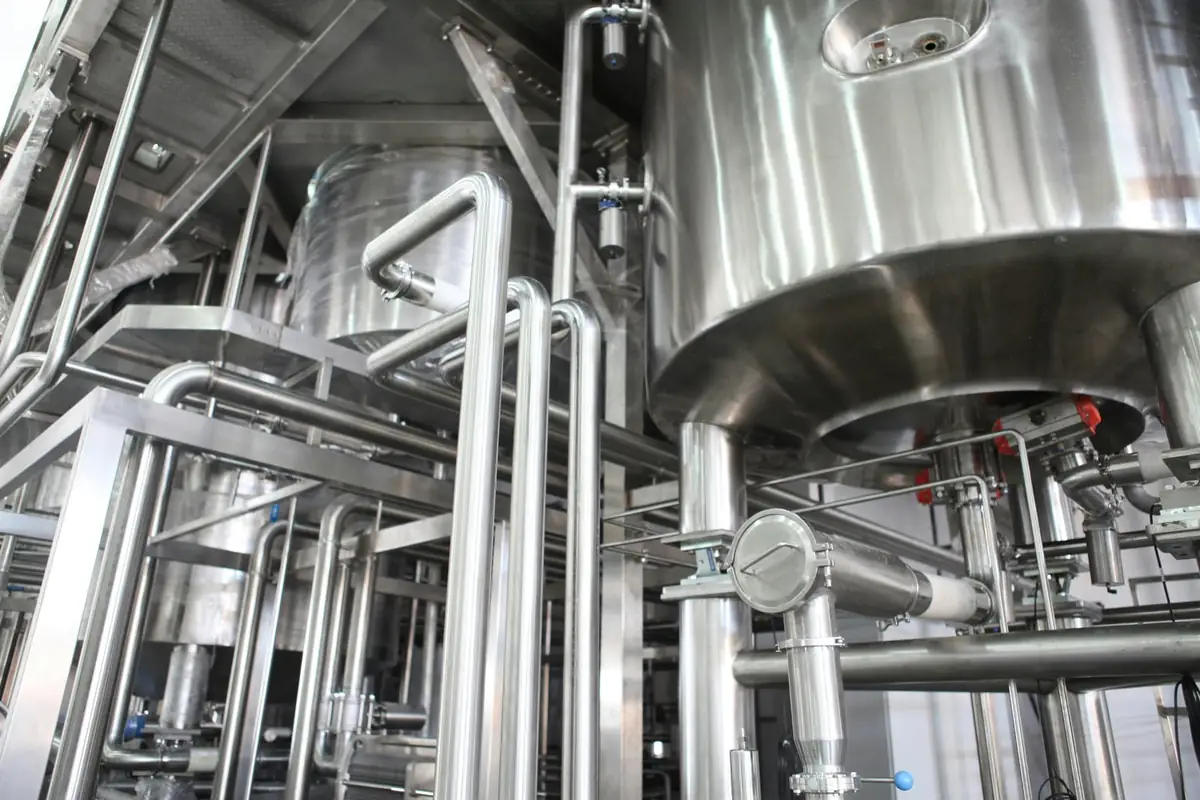
Batch on the process side. Packs on the line. One record from flour to pallet.
An FMCG (Fast-Moving Consumer Goods) plant is two plants in one. The front half runs in kilograms and batches. The back half counts packs, cartons and pallets. VECHR MES runs both and keeps the link between them.
VECHR MES weighs materials with FEFO, reads CCP values from the PLC, carries the batch across into packs and pallets, and traces any pallet back to its supplier lots.
Worked example: flour becomes 8,400 kg of noodle block, then 120,000 packs on 51 pallets.
- 8,400 kg of noodle block, in 28 batches
- 120,000 packs from one order
- 51 pallets, each with its own SSCC
- Product
- Mie Goreng 85 g instant noodles (fictional reference plant)
- SFG order
- 8,400 kg of noodle block = 28 batches of 300 kg
- FG order
- 120,000 packs = 3,000 cartons of 40 = 51 pallets of 60 cartons
- Orders
- Two linked orders, SFG and FG, start-to-start with a lag
- Machines
- Scales, PLCs on steamer and fryer, checkweigher, metal detector, palletizer
Three quantities stay separate at the hybrid boundary: the conversion (how many packs a kilogram should make), actual production (how many were made, and where the rest went) and genealogy (which SFG batch went into which FG batch).
Walk the line, stage by stage.
Six stages, from the scale to the warehouse. Scroll to follow the batch.
-
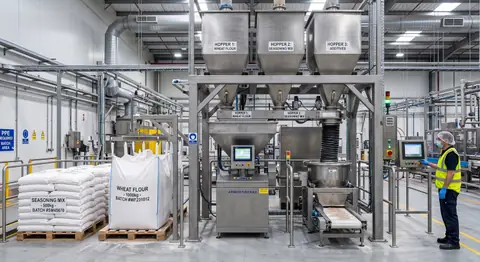 01 kg Material preparation VECHR MES records Scale tare and gross, FEFO lot choice
-
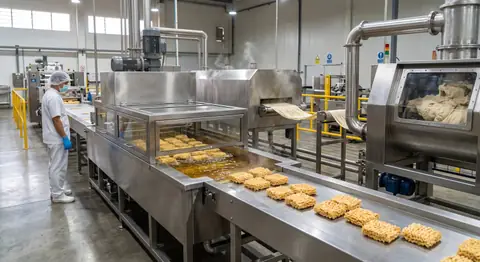 02 batch Mix, steam, fry VECHR MES records CCP temperatures and times from the PLC
-
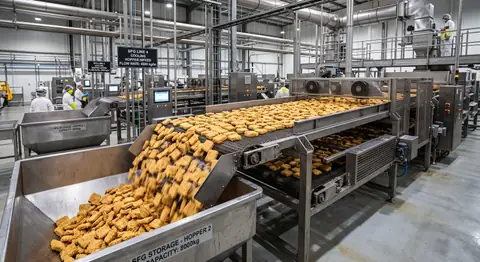 03 kg · SFG lot SFG holding VECHR MES records The batch ID travels on to packing
- Mass becomes count
-
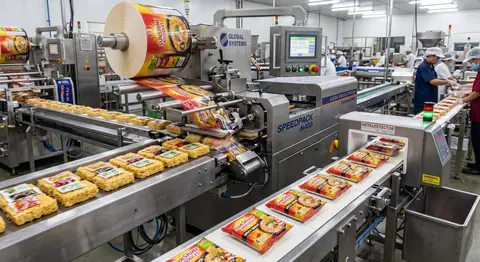 04 packs Primary packing VECHR MES records Good count and rejects by reason
-
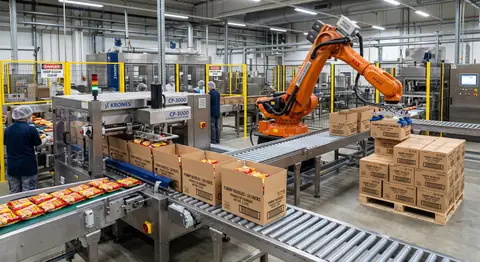 05 cartons · pallet Cartons and pallets VECHR MES records SSCC and net weight per pallet
-
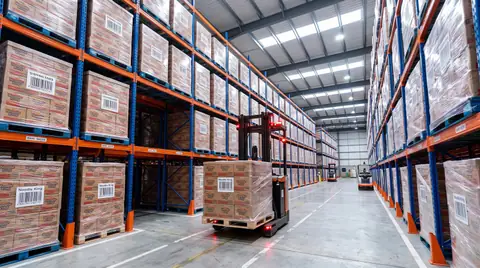 06 pallet Goods receipt VECHR MES records Receipt posted to SAP, pallet by pallet
Every record crosses a boundary once, from the system that owns it.
| Record | Owned by | What the other side does |
|---|---|---|
| Material master, BOM, released order | SAP | VECHR MES copies the order at release, with the BOM (Bill of Materials) frozen on it |
| Stock and stock status | SAP | VECHR MES posts the movements and never keeps a competing inventory |
| Routing and step checks | VECHR MES | SAP keeps the confirmation operations |
| Execution: who, what, where, when | VECHR MES | Confirmations, downtime and approved hours go to SAP |
| Batch number and genealogy | Batch number: SAP or VECHR MES, never both. Genealogy: VECHR MES | The batch travels on every posting |
| Machine connection and local history | Edge Agent | Counts, weights and states go to VECHR MES |
Weights, CCP values and rejects are recorded at the step where they happen.
Today Weights are written on paper next to the scale.
With VECHR MES The scale is read at consumption. Expired or blocked stock is refused.
Today CCP (Critical Control Point) readings are copied by hand, if at all.
With VECHR MES Steam and fry values come from the PLC (Programmable Logic Controller), locked and stored on the batch.
Today A recall means days of spreadsheets.
With VECHR MES Any pallet traces back to its flour, oil and seasoning lots.
Today OEE (Overall Equipment Effectiveness) is a guess at month end.
With VECHR MES Availability, performance and quality per line, with downtime reasons.
How to read the status: Ready runs on the standard product. Configured is assembled in your project from existing building blocks, without new code. Built on request is developed once discovery confirms the need.
| Stage | How VECHR MES handles it | Status |
|---|---|---|
| Staging stock | Staged material lots sit at a staging location. End-of-shift counts are audited adjustments. | Ready |
| Issue control | Each BOM line is either issued from a lot or quantity-only (water). Frying oil is metered by flow or backflushed by SAP. | Ready Configured in your project |
| Weigh and consume | The scale's tare and gross are read and locked. FIFO (First In, First Out) or FEFO (First Expired, First Out) is suggested, and an override needs a reason. Expired or blocked stock is refused. | Ready |
| Shelf life | Expiry is set at receipt from the shelf life, or taken from SAP. | Ready |
| CCPs | Data collection bound to the PLC fills itself, read-only for the operator, stored against the batch. | Ready |
| Out of limits | One non-conformance per failed parameter. A critical one holds the batch. Holding on every CCP failure is one flow. | Ready Configured in your project |
| Non-conformance and release | Open, review, investigation, disposition, closed. Batch release is e-signed with re-authentication and a hash chain. | Ready Configured in your project |
| Units of measure | Packs, cartons, pallets and kilograms as alternative units, carried on every record. | Ready |
| Pallets | Each pallet gets an SSCC (Serial Shipping Container Code) and a carton count. The batch cannot move out until every pack is on a closed pallet. | Ready |
| Catch-weight | Actual net weight next to the count, with tolerance and an override reason. | Ready |
| Work instructions | Revisioned per step. Read-and-acknowledge is signed. Used for line clearance, allergen and start-up checks. | Ready |
Six HACCP gates, enforced at the step.
HACCP (Hazard Analysis and Critical Control Points) means food-safety hazards are controlled at critical points. The limits come from the specification. A failed check raises a non-conformance on the spot.
HACCP checks enforced at the step, not reviewed after the shift.
- Incoming lots checked for status and expiry before use
- CCP limits come from the specification. Out of limits raises a non-conformance.
- A critical finding holds the batch automatically
- Line clearance and allergen checks as signed work instructions
- Batch release e-signed, on a hash-chained record
- The batch record exports as a PDF per unit
Each machine signal becomes an MES transaction.
The Edge Agent evaluates triggers in the plant and queues them while the server link is down. The operator terminal offers the same action by hand.
| Machine signal | What happens in VECHR MES | Status |
|---|---|---|
| Packer good count | Output quantity on the FG batch, per shift or per pallet | Configured in your project |
| Checkweigher reject count | Scrap with a reason | Configured in your project |
| Metal-detector reject | Critical non-conformance, batch on hold | Configured in your project |
| Machine run, stop, fault | Resource state, with the reason added by the operator | Configured in your project |
| Palletizer pallet done | Pallet closed with SSCC and net weight | Configured in your project |
| Batch starts at the packer | Batch and best-before written to the code-date printer | Configured in your project |
OEE is availability × performance × quality, for example 88.8 % × 93.7 % × 99.0 % = 82.4 %, with downtime reasons, MTBF (Mean Time Between Failures), MTTR (Mean Time To Repair) and microstops alongside.
A pallet traces back to its supplier lots.
Every consumption records the link from the lot used to the unit that used it. The batch record exports as a PDF per unit.
A recall, step by step.
- 1 Block the supplier lot SAP blocks it, and VECHR MES refuses it at once.
- 2 Find the FG batches Genealogy lists every batch that used it.
- 3 Hold what is still in production Holds in VECHR MES, finished stock blocked in SAP.
- 4 Pallets to deliveries SSCCs lead to the deliveries in SAP.
- 5 Close it out One non-conformance per batch, disposition recorded.
Trace runs one level per query. A packaging recall is one hop, a flour recall is two. A mass-balance recall report is configured in the project.
The fryer sets the pace for the whole plant.
Advanced Scheduling detects the bottleneck and paces everything upstream to it.
- Drum The bottleneck that limits the whole plant. VECHR MES detects it automatically from the load.
- Buffer How many minutes earlier the steps before the drum start, so it never waits.
- Rope The release rule: upstream work starts at drum free minus buffer. Steps after the drum run forward.
Illustrative timing: the operations before the bottleneck take 45 minutes, and the bottleneck is free at 10:00.
| Need | How it is handled |
|---|---|
| Bottleneck pacing | Drum-Buffer-Rope paces the schedule to the fryer |
| Flavour and allergen changeovers | A changeover matrix per resource, from product to product |
| Sanitation and CIP | Cleaning time on the resource schedule |
| SFG to FG link | Start-to-start dependency with a lag, so packing opens while frying continues |
| Tanks | Occupancy, fill-time limits, cleaning and cooldown |
| Capacity | Shifts, calendars, breakdowns, labour shifts and standard rates |
The scheduler adds changeover time for the sequence it builds. It does not reorder to minimise changeovers, so the flavour wheel stays with the planner.
Orders come down from SAP. Postings go back up.
SAP keeps stock and planning. VECHR MES runs the floor and posts the movements, so there is never a competing inventory.
Each SAP posting is a flow on an event that already exists.
| SAP movement | Posted when | Status |
|---|---|---|
| Goods issue (261) | Material is consumed, per lot per batch or per shift | Configured in your project |
| SFG goods receipt (101) into quality stock | The SFG check step completes, per batch | Configured in your project |
| FG goods receipt (101) into quality stock | A pallet is closed, with SSCC, packs, cartons and net weight | Configured in your project |
| Scrap (551 or confirmation scrap) | Scrap is recorded, per shift | Configured in your project |
| Release, block, reject (321, 344, 350) | QA (Quality Assurance) releases, holds or rejects the FG batch | Configured in your project |
| Partial and final confirmation | Output moves out and the order changes status | Configured in your project |
| Downtime to PP or PM | A machine stop is closed with its reason | Configured in your project |
Interface rules
- Orders come in by API push or a timed pull, matched by order number first
- SAP dates are planned dates. Scheduled dates belong to the scheduler.
- The BOM is copied onto the order at release, so a later SAP change does not alter it
- The batch number comes from SAP or from VECHR MES, never both
- An SAP block comes back as stock status, and only unrestricted stock can be consumed
- A staging table with nightly reconciliation makes every posting exactly-once
About 390 postings per SKU (Stock Keeping Unit) per day in the reference example. Aggregating carton and pallet issues per shift removes about 145.
42 of 48 typical requirements run on the standard product, with no code written.
26 ready · 16 configured · 6 on request, out of 48 typical requirements
Ready26
- Order execution, routing, operator terminal
- Weighing, FIFO and FEFO, shelf life
- Genealogy from raw material to pallet
- CCP data collection, non-conformance, hold, e-signatures
- Pallets with SSCC, catch-weight, alternative units
- DBR, changeover matrix, cleaning, tanks
- Labour, certification, maintenance
- Edge: OPC UA, Modbus TCP, MQTT
- Batch record PDF, OEE, BOM analysis, AI Insight
Configured in your project16
- SAP postings: goods issue, receipt, confirmation, scrap, stock status
- Inbound stock interface, including SFG coming back
- Staging table with dedupe, retry and reconciliation
- Hold on every CCP failure
- Machine counters to output, scrap and downtime
- Mass-balance recall and yield reports
- Labour hours to payroll
Built on request6
- Label and QR print engine integration
- Recipe and potency adjustment
- Line replenishment requests
- AQL (Acceptable Quality Limit) sampling, COA (Certificate of Analysis), retain samples (or SAP QM, LIMS)
- SPC charts, Cpk and Ppk
- OEE roll-up by line, area and plant
Proof of Concept: one packing line, one SKU, 4 to 6 weeks.
Run against an SAP sandbox. Pallets with SSCC, catch-weight and units are in scope. Label printing and recipe logic are not.
| Area | Acceptance criterion |
|---|---|
| Order inbound | The released order appears in VECHR MES without re-keying |
| Consumption | The FEFO lot is suggested, and overrides are in the audit trail |
| Machine output | Shift output within ±0.5 % of the machine counter |
| SAP postings | Every pallet receipt and shift issue has an SAP document the next morning, with zero reconciliation differences |
| Genealogy | FG batch to packaging lots in one view |
| OEE | Availability, performance and quality per shift, with downtime reasons |
Decisions we make together in the first workshop.
- Goods movement granularity: per lot or per shift, per pallet or per order
- Who owns the batch number, and its format
- One process order or two (SFG and FG)
- Where pallet SSCCs come from, and who prints labels
- Automatic hold on every CCP failure
- Which machines expose a PLC, and on which protocol
What changes, order by order.
Illustrative inputs from the worked example. Your own figures replace them in the Workshop Assessment.
| What changes | Today | With VECHR MES |
|---|---|---|
| Fryer downtime, the line that sets the pace | 0.9 h a shift | 0.8 h a shift |
| Overfill on the 70 g block | 1.22 % | 1.00 % |
| Rejects at the packer | 1.0 % | 0.9 % |
| Batch-record reviews and SAP postings | Typed and checked by hand | Reviewed on screen, posted by flows |
Frequently Asked Questions
Does VECHR MES replace SAP?
No. SAP keeps planning, stock and costing. VECHR MES runs execution and posts goods issue, goods receipt, scrap and confirmations back.
How does it handle the switch from kilograms to packs?
The SFG (Semi-Finished Goods) batch is consumed into the finished-goods order, which records the genealogy link. Packs, cartons, pallets and kilograms are alternative units on the same material.
Can we schedule around the fryer?
Yes. Drum-Buffer-Rope paces the whole schedule to the bottleneck, with changeover times per product pair and cleaning built in.
Do our checkweigher and metal detector connect?
Yes, through the Edge Agent over OPC UA, Modbus TCP or MQTT. Each signal becomes an MES transaction through a flow configured in your project.
Keep reading
- Halal traceability on the shop floor: the evidence you have to be able to produce A halal certificate covers a product. The claim has to hold for every batch. Here is the chain of evidence an SJPH audit follows, the three points where it usually breaks, and how a production system keeps it intact.
- How to calculate OEE, with a worked example and the usual mistakes OEE is Availability times Performance times Quality. Here is the formula, a full worked shift, why manually calculated OEE is almost always too high, and how to read the number properly.
- Finite capacity scheduling: why the ERP schedule keeps getting rewritten ERP builds schedules as though capacity were always free, which is why the sequence gets rebuilt on the shop floor. Here is what finite capacity scheduling means, the four scheduling strategies, and why tanks and pumps need different treatment.
Terms on this page(32)
- APIApplication Programming Interface
- The way one system calls another, such as SAP sending orders to VECHR MES.
- AQLAcceptable Quality Limit
- The highest defect rate a sampling inspection still accepts for a lot.
- BOMBill of Materials
- The list of materials, and how much of each, needed to make one product.
- CCPCritical Control Point
- A step where a hazard must be controlled for the food to be safe, such as frying temperature. Part of HACCP.
- CIPClean-in-Place
- Cleaning tanks and pipes without taking the equipment apart.
- COACertificate of Analysis
- The test results that come with a lot, from the supplier or the lab.
- DBRDrum-Buffer-Rope
- A scheduling method that paces the whole line to its bottleneck (the drum).
- EWMExtended Warehouse Management
- SAP's warehouse module.
- FEFOFirst Expired, First Out
- Use the material that expires soonest first.
- FGFinished Goods
- The packed product, ready to ship.
- FIFOFirst In, First Out
- Use the material that arrived first, first.
- FMCGFast-Moving Consumer Goods
- Everyday products that sell fast: food, drinks, personal care, home care.
- HACCPHazard Analysis and Critical Control Points
- A food-safety system: find the hazards in the process, then control them at fixed points (CCPs).
- LIMSLaboratory Information Management System
- The lab's own system for samples, tests and results.
- MESManufacturing Execution System
- The system that runs and records production on the floor: orders, materials, steps, quality and machines.
- MMMaterials Management
- SAP's module for materials, stock and purchasing.
- Modbus TCPModbus over TCP/IP
- A long-established industrial protocol, carried over an Ethernet network.
- MQTTMessage Queuing Telemetry Transport
- A lightweight publish/subscribe protocol for sending machine data.
- MTBFMean Time Between Failures
- The average running time between one breakdown and the next.
- MTTRMean Time To Repair
- The average time it takes to get a machine running again after a breakdown.
- OEEOverall Equipment Effectiveness
- Availability × performance × quality: how much of the planned time turned into good product.
- OPC UAOPC Unified Architecture
- The open standard for reading data from PLCs and machines securely.
- PLCProgrammable Logic Controller
- The industrial computer that controls a machine and holds its live values.
- PMPlant Maintenance (SAP PM)
- SAP's maintenance module.
- PPProduction Planning
- SAP's module for production orders and planning. PP-PI is the process-industry variant.
- QAQuality Assurance
- The team that releases product and owns the quality system.
- QMQuality Management
- SAP's quality module: inspection lots, results and usage decisions.
- SAPSAP ERP
- The ERP most large Indonesian manufacturers run. S/4HANA is its current generation.
- SFGSemi-Finished Goods
- Product that is made but not yet packed, such as noodle block before packing.
- SKUStock Keeping Unit
- One sellable product variant, such as one flavour in one pack size.
- SPCStatistical Process Control
- Charting measurements over time to catch drift before it becomes a reject.
- SSCCSerial Shipping Container Code
- The 18-digit GS1 number that identifies one pallet or shipping unit.
See VECHR MES on your own process.
A walkthrough built around how your plant runs. Not a generic demo.