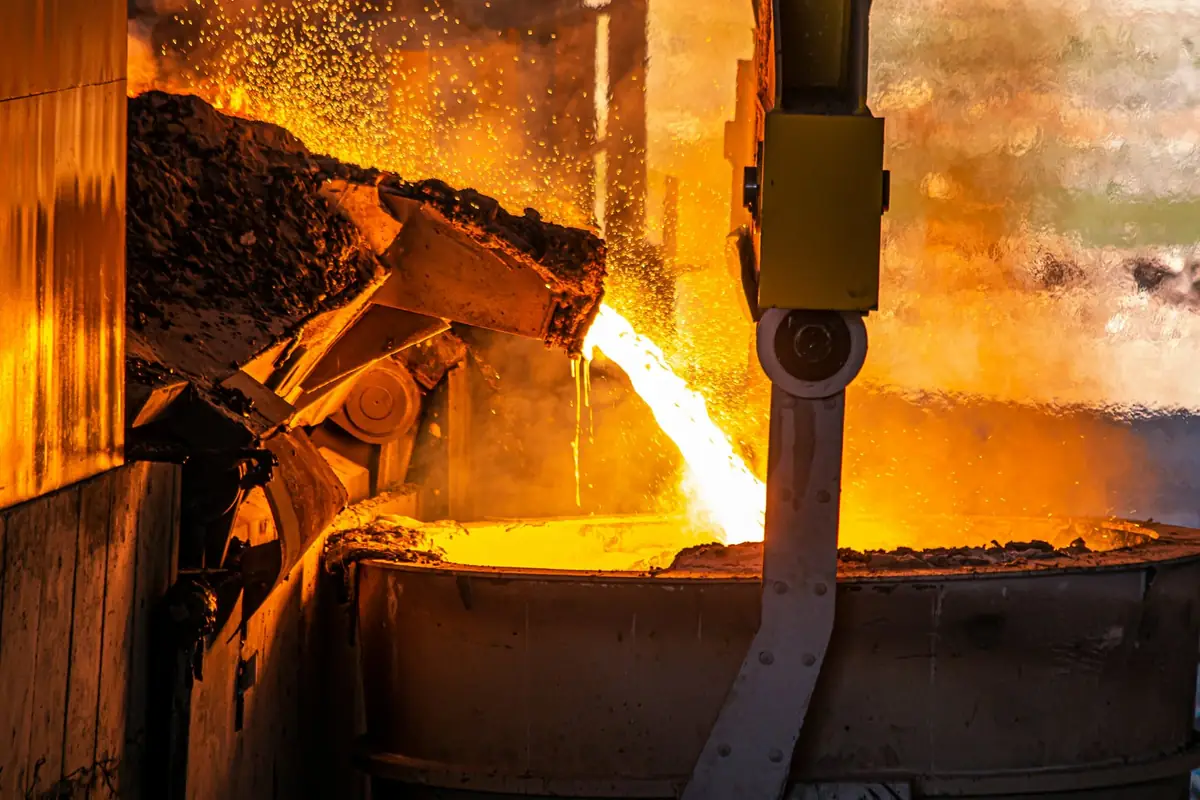
From the heat to the certified coil, every tonne keeps its history.
A steel mill merges and splits its product at every stage. Two heats become one cast, the cast becomes slabs, each slab becomes a coil. VECHR MES keeps every link.
Each heat, cast, slab and coil is booked as it happens, with chemistry and process limits checked. A bad heat traces to its coils in minutes, and every coil carries a report with an integrity hash.
Worked example: two heats become one cast, six slabs and six coils.
- 2 heats of about 65 to 70 t, merged into one cast
- 6 slabs split from the cast
- 6 coils, each traced back to both heats
- Plant
- 70 t EAF mill, Plant Serang-1 (fictional)
- Heats
- HT-001 (68 t) and HT-002 (65 t)
- Cast
- CAST-A, 133 t, cut into six slabs of about 22.2 t
- Coils
- Six coils, 130 t of SS400, 3.0 × 1,219 mm
- Followed coil
- COIL-000091, 21.8 t, rolled from slab 04
Two orders: a melt-shop order from heat to slab, and a rolling order from slab to coil. SAP owns stock, and the slab comes back as stock for the rolling order.
Walk the mill, from melt shop to dispatch.
Six stages. Scroll to follow the metal.
-
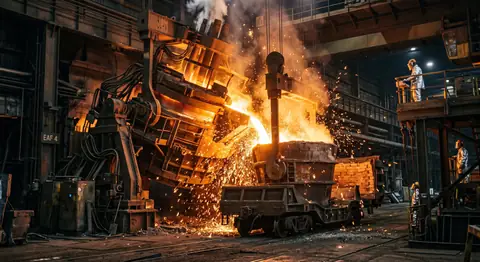 01 heat EAF melting VECHR MES records Charge lots consumed, tap temperature
-
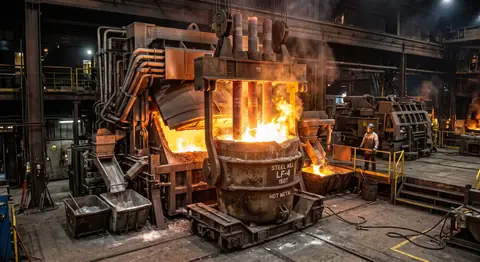 02 heat Ladle furnace VECHR MES records Final chemistry against grade limits
- Liquid becomes slab
-
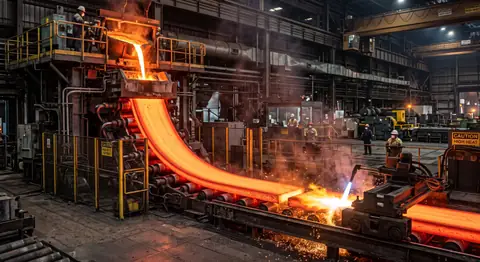 03 cast → slabs Continuous casting VECHR MES records Heats merged, the cast split into slabs
-
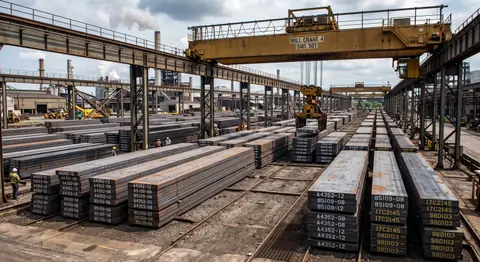 04 slab Slab yard VECHR MES records Surface and size, conditioning as rework
-
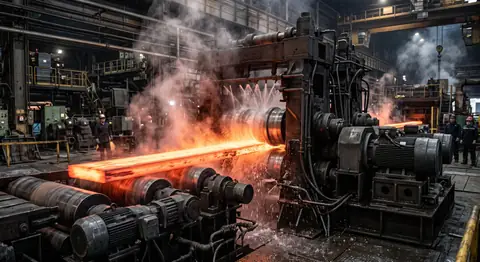 05 coil Reheat and hot strip mill VECHR MES records One slab, one coil, real weight from the scale
-
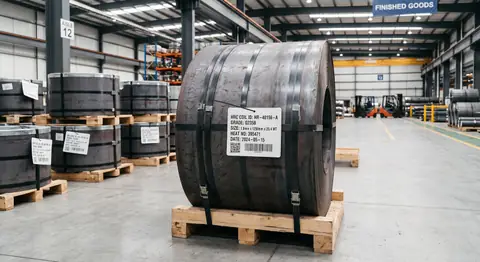 06 coil Test, certify, ship VECHR MES records Tensile and yield, QA release before dispatch
Level 2, the lab and SAP keep their roles. VECHR MES connects them.
| Record | Owned by | What the other side does |
|---|---|---|
| Process orders, grades, charge and alloy stock | SAP | Copied into VECHR MES at release |
| Slab and coil stock | SAP | VECHR MES posts receipts, and the slab returns as stock for rolling |
| Heat, cast, slab and coil execution | VECHR MES | Confirmations with tonnes, kWh and hours go to SAP |
| Heat report, chemistry, process values | Level 2, spectrometer, LIMS | Values land on the heat and cast in VECHR MES |
| Heat number, grade, aim chemistry | VECHR MES | Sent to Level 2 when the heat starts |
| Genealogy from charge lot to coil | VECHR MES | The batch travels on every posting |
Each heat, cast, slab and coil is booked as it happens.
Today Which coils came from heat 002? Someone digs through paper.
With VECHR MES Heat lineage finds the slabs in seconds, and the coils in minutes.
Today Chemistry is retyped from the lab report.
With VECHR MES One parameter per element with limits. Off-spec raises a non-conformance.
Today Downgrades and remelts are decided off the record.
With VECHR MES Downgrade, remelt and scrap are recorded paths, each with a reason.
Today Delays are coded at the end of the shift.
With VECHR MES Resource states with reasons, plus MTBF (Mean Time Between Failures) and MTTR (Mean Time To Repair) per resource.
How to read the status: Ready runs on the standard product. Configured is assembled in your project from existing building blocks, without new code. Built on request is developed once discovery confirms the need.
| Stage | How VECHR MES handles it | Status |
|---|---|---|
| Charge | Scrap, DRI (Direct Reduced Iron), lime and alloys consumed per lot into the heat, or taken from the Level 2 heat report | Ready Configured in your project |
| Melt and refine | The heat is a process unit. The ladle furnace is modelled as a tank, one heat per ladle. | Ready |
| Chemistry | One parameter per element with min and max, from the spectrometer by flow | Ready Configured in your project |
| Cast | Two heats merged with a stated reason, then split into six slabs. Every slab lists both heats. | Ready |
| Slab inspection | Surface and dimensions, conditioning as a rework loop, receipt per slab | Ready |
| Hot rolling | One coil consumes one slab. Coil weight from the scale is the output quantity. | Ready |
| Final inspection | Pass to dispatch, or downgrade, remelt or scrap as recorded alternative paths | Ready Configured in your project |
Limits at every stage, from tap to tensile.
An out-of-limit value raises a non-conformance automatically. QA escalates, or a flow holds the cast and its slabs.
Quality decisions and certificates that stand up to a customer audit.
- Chemistry and process limits checked automatically
- Out of limits raises a non-conformance. A critical one holds the material.
- Disposition recorded: use as is, rework, reprocess, scrap or reject
- Coils released by QA (Quality Assurance) before dispatch
- A coil report as a PDF with an integrity hash
- Full genealogy from coil back to charge lots
Level 2, the lab and the meters feed the heat record.
Process values are collected automatically. Systems with their own interfaces connect through Process Orchestrator flows.
| Machine signal | What happens in VECHR MES | Status |
|---|---|---|
| Temperatures, casting speed, mould level | Values on the heat or cast, non-conformance out of range | Ready |
| Spectrometer result, EAF heat report | Chemistry, charge consumption and power per heat | Configured in your project |
| Heat start at the EAF | Heat number and aim chemistry written to Level 2 | Configured in your project |
| Sustained mould-level excursion | Critical non-conformance, cast held, supervisor notified | Configured in your project |
| Coil scale weight | Coil moved out with its real weight | Configured in your project |
Delays are recorded as resource states with reasons and time categories, with availability, performance and quality, MTBF and MTTR per resource.
A bad heat is traced to its coils in minutes.
The model over-reports by design. Every slab of the cast lists both heats, so a recall never misses one.
A recall, step by step.
- 1 Start from the heat Heat lineage lists its slabs in seconds.
- 2 Slabs to coils A backward trace per slab finds the coils in minutes.
- 3 Shipped or not Each coil shows whether it has been dispatched.
- 4 Hold what is still here Undispatched coils are held at once.
- 5 Block in SAP Stock is blocked in SAP for every affected coil.
Each coil carries a report as a PDF with an integrity hash. Heat chemistry can be copied onto the coil by a flow, or the mill test certificate printed from SAP QM.
The EAF sets the pace. Slabs pass through SAP stock.
Drum-Buffer-Rope paces the melt shop to its bottleneck, with the ladle furnace modelled as a tank.
- Drum The bottleneck that limits the whole plant. VECHR MES detects it automatically from the load.
- Buffer How many minutes earlier the steps before the drum start, so it never waits.
- Rope The release rule: upstream work starts at drum free minus buffer. Steps after the drum run forward.
Illustrative timing: the operations before the bottleneck take 45 minutes, and the bottleneck is free at 10:00.
| Need | How it is handled |
|---|---|
| Bottleneck pacing | DBR with the EAF or caster as the drum |
| Ladle furnace | Modelled as a tank, one heat per ladle |
| Changeovers | A changeover matrix per resource |
| Between areas | Slab stock between the melt shop and the mill |
| Labour | Crews, certification checked at planning, hours on the confirmation |
| Energy | Meters read and trended. Energy per heat by a flow configured in the project. |
Campaign rules, tundish life, rolling campaigns and energy-aware melting are not modelled today.
Orders and grades come down. Slab and coil receipts go back up.
Level 2, the lab and SAP each keep their role. VECHR MES connects them around the heat.
Every slab and coil reaches SAP as a posting.
| SAP movement | Posted when | Status |
|---|---|---|
| Process orders in | SAP pushes through the API, or a timed pull | Configured in your project |
| Charge and alloy goods issue (261) | Charge material is consumed into the heat, or backflushed | Configured in your project |
| Slab goods receipt (101) into quality stock | The slab passes inspection | Configured in your project |
| Slab issue (261) and coil receipt (101) | Rolling consumes the slab and coils the strip | Configured in your project |
| Batch characteristics, usage decision | Chemistry recorded, holds and non-conformances raised | Configured in your project |
| Downgrade and home scrap | A downgrade or a scrap and remelt is recorded | Configured in your project |
| Confirmation and delays | Output, order status, labour, energy and resource states | Configured in your project |
Interface rules
- Decide what the SAP batch is: heat, cast, slab or coil
- The slab comes back from SAP as stock for the rolling order
- SAP dates are planned dates. The BOM (Bill of Materials) is copied at release.
- A staging table with nightly reconciliation is recommended for exactly-once postings
Execution, quality and genealogy run today. SAP and Level 2 are configured flows.
Ready
- Heat, cast, slab and coil execution, merge, split, consume
- Chemistry and process limits, automatic non-conformance, hold
- Downgrade, remelt and scrap paths, e-signature
- Advanced Scheduling with DBR and the ladle as a tank
- Labour tracking
- Meters and signals through the Edge Agent
- Delay coding, OEE (Overall Equipment Effectiveness), maintenance, meter trends
- API Gateway for SAP to push orders
Configured in your project
- Level 2, lab and mill test certificate chemistry flows
- SAP posting flows
- Energy per heat
- Transition slab, grade catalogue, home scrap
- Recall search from heat to coil
Built on request
- Yield per heat and stage
- Campaign rules, tundish and roll life by use
- Coil reallocation, coil tags
- Energy per shift and per tonne, meter hierarchy, tariffs
- Posting log package
Proof of Concept: one grade, one cast a day, melt shop to slab receipt, 4 to 6 weeks.
Against an SAP sandbox, with your Level 2 tags and your energy meters.
| Area | Acceptance criterion |
|---|---|
| Orders and charge lots | Come from the SAP sandbox, with no re-keying |
| Heat, cast, slabs | Every slab traces to its heats and charge lots |
| Chemistry and Level 2 | Values on the heat within a minute, and an off-spec value raises a non-conformance |
| Energy per heat | kWh on each heat, matching the meter within 1 % |
| SAP postings | Documents for every slab the next morning, with zero reconciliation differences |
| Yield per heat | Charge, tapped and cast tonnes, agreed with the mill's own figure |
Decisions we make together in the first workshop.
- One SAP order per area, or one from heat to coil, and whether you hot-charge
- What the SAP batch is: heat, cast, slab or coil
- Charge issued per bucket, or backflushed
- Who prints the mill test certificate: SAP QM or the MES
- What Level 2 sends and receives, and in which form
- Which equipment paces the shop
What changes, cast by cast.
Illustrative inputs from the worked example. Your own figures replace them in the Workshop Assessment.
| What changes | Today | With VECHR MES |
|---|---|---|
| Metal lost between cast and coil | 3.0 t a cast | 2.8 t a cast |
| Electricity per tonne | 400 kWh/t | 394 kWh/t |
| Mill test certificates and SAP postings | Prepared by hand | From the coil record, posted by flows |
Frequently Asked Questions
Can VECHR MES schedule a melt shop?
Yes. Drum-Buffer-Rope paces the schedule to the EAF (Electric Arc Furnace) or caster, with the ladle furnace modelled as a tank and changeovers per resource.
Does it connect to our Level 2 systems?
Yes, through REST and database connectors in the Process Orchestrator, configured in your project.
How fast is a recall on one heat?
Heat lineage finds the slabs in seconds. Tracing each slab to its coil takes minutes. Coils not yet dispatched can be held at once.
Do you track energy per heat?
Meters are read and trended through the Edge Agent. Energy per heat is calculated by a flow configured in your project.
Keep reading
- MES vs ERP vs SCADA: what does each one actually do? ERP holds the plan, SCADA monitors and controls the machines, and MES connects the two through the real production process. Here is how they differ, what each one owns, and why one cannot simply replace another.
- OPC UA vs MQTT: not a choice between two competitors OPC UA carries meaning. MQTT carries messages efficiently. They solve different halves of the same problem, and most plants end up running both. Here is what each actually does and how to decide per connection.
- ISA-95 explained: the five levels and where an MES sits ISA-95 (IEC 62264) divides manufacturing into five levels, from the physical process up to business planning. Here is what each level does, why Level 3 is so often the empty one in a plant, and how the model helps connect IT with operations.
Terms on this page(15)
- APIApplication Programming Interface
- The way one system calls another, such as SAP sending orders to VECHR MES.
- BOMBill of Materials
- The list of materials, and how much of each, needed to make one product.
- DBRDrum-Buffer-Rope
- A scheduling method that paces the whole line to its bottleneck (the drum).
- DRIDirect Reduced Iron
- Iron ore reduced to metal without melting. Fed to the furnace alongside scrap.
- EAFElectric Arc Furnace
- The furnace that melts scrap and DRI into liquid steel with an electric arc.
- LIMSLaboratory Information Management System
- The lab's own system for samples, tests and results.
- MESManufacturing Execution System
- The system that runs and records production on the floor: orders, materials, steps, quality and machines.
- MMMaterials Management
- SAP's module for materials, stock and purchasing.
- MTBFMean Time Between Failures
- The average running time between one breakdown and the next.
- MTTRMean Time To Repair
- The average time it takes to get a machine running again after a breakdown.
- OEEOverall Equipment Effectiveness
- Availability × performance × quality: how much of the planned time turned into good product.
- PPProduction Planning
- SAP's module for production orders and planning. PP-PI is the process-industry variant.
- QAQuality Assurance
- The team that releases product and owns the quality system.
- QMQuality Management
- SAP's quality module: inspection lots, results and usage decisions.
- SAPSAP ERP
- The ERP most large Indonesian manufacturers run. S/4HANA is its current generation.
See VECHR MES on your own process.
A walkthrough built around how your plant runs. Not a generic demo.