MES vs ERP vs SCADA: what does each one actually do?
ERP holds the plan: what should be made, how much, when it is due, and what it means for the business. SCADA monitors and controls what is happening at the equipment in real time. MES sits in the middle: it turns the plan into a process that can be executed, records what actually happened on the shop floor, and carries that real data back up to the ERP.
Three systems, three different questions
ERP, MES, and SCADA often sound like three interchangeable things. Each has a different role.
Misunderstanding those roles can lead a plant to buy a system that does not match its needs. Or to assume it already has a capability it does not.
The simplest way to tell them apart is to look at the question each one answers:
| ERP | MES | SCADA | |
|---|---|---|---|
| Answers | What should happen? | What is happening, and what did happen? | What is the machine doing right now? |
| Works in | Orders, quantities, cost, dates | Orders, production steps, batches, lots, operators | Tags, setpoints, alarms |
| Time horizon | Weeks to months | Minutes to shifts | Milliseconds to seconds |
| Typical users | Planning, purchasing, finance | Production, quality, maintenance | Control engineers, operators |
| Owns | The plan and the business or financial record | Production execution and traceability | Equipment supervision and control |
| ISA-95 level | Level 4 | Level 3 | Level 2 |
Put simply:
ERP decides what needs to be done. MES manages how that plan is carried out and records the result. SCADA sees and controls what is happening at the equipment in real time.
ERP: where the plan is made
The ERP manages what should be produced, how much, when it is due, and what it means for the business.
This is normally where production orders, bills of material, material requirements, schedules, and cost information live.
An ERP is not designed to follow every detail happening on the shop floor.
It may know that you need to produce 4,000 units.
What it usually does not know is that 1,200 of them are currently on line 2, that step 40 is blocked because the filler is being cleaned, or that operator Rina completed the final inspection at 14:12.
That kind of detail belongs to the production execution layer.
Asking the ERP to handle all of it means pushing it into a role designed for another kind of system.
SCADA: where the machines are watched
SCADA, together with the HMIs alongside it, focuses on what is happening at the equipment.
It reads tag values, monitors process conditions, drives setpoints, and raises alarms within seconds or faster. This is where the physical process is monitored and controlled.
What SCADA does not carry is the full business and production context.
SCADA knows that tank TK-03 is at 46°C.
What it does not necessarily know is that the tank is being used for production order PO-2317, made from cocoa mass lot COCO-2026-A01, and that once this step finishes a QA sample has to be taken.
That context is what turns a temperature reading into part of the production and quality record.
This is exactly where the MES sits. It connects equipment data to the order, the material, the operator, and the production process currently running.
MES: the bridge
The MES is the layer that connects the two.
It translates the planning language of the ERP into a process that can be executed on the shop floor. It also carries the real conditions from the equipment back up to the systems above.
It takes the production order from the ERP and expands it into a routing: an ordered set of production steps, each with its qualified equipment, its materials, its work instructions, and its quality checks.
On the other side, it reads the data SCADA and the PLCs already produce and attaches it to the order, batch, lot, and process currently running.
The real outcome then goes back up: how much was completed, how much was scrapped or reworked, and when it happened.
With that context, several capabilities become possible at the MES layer:
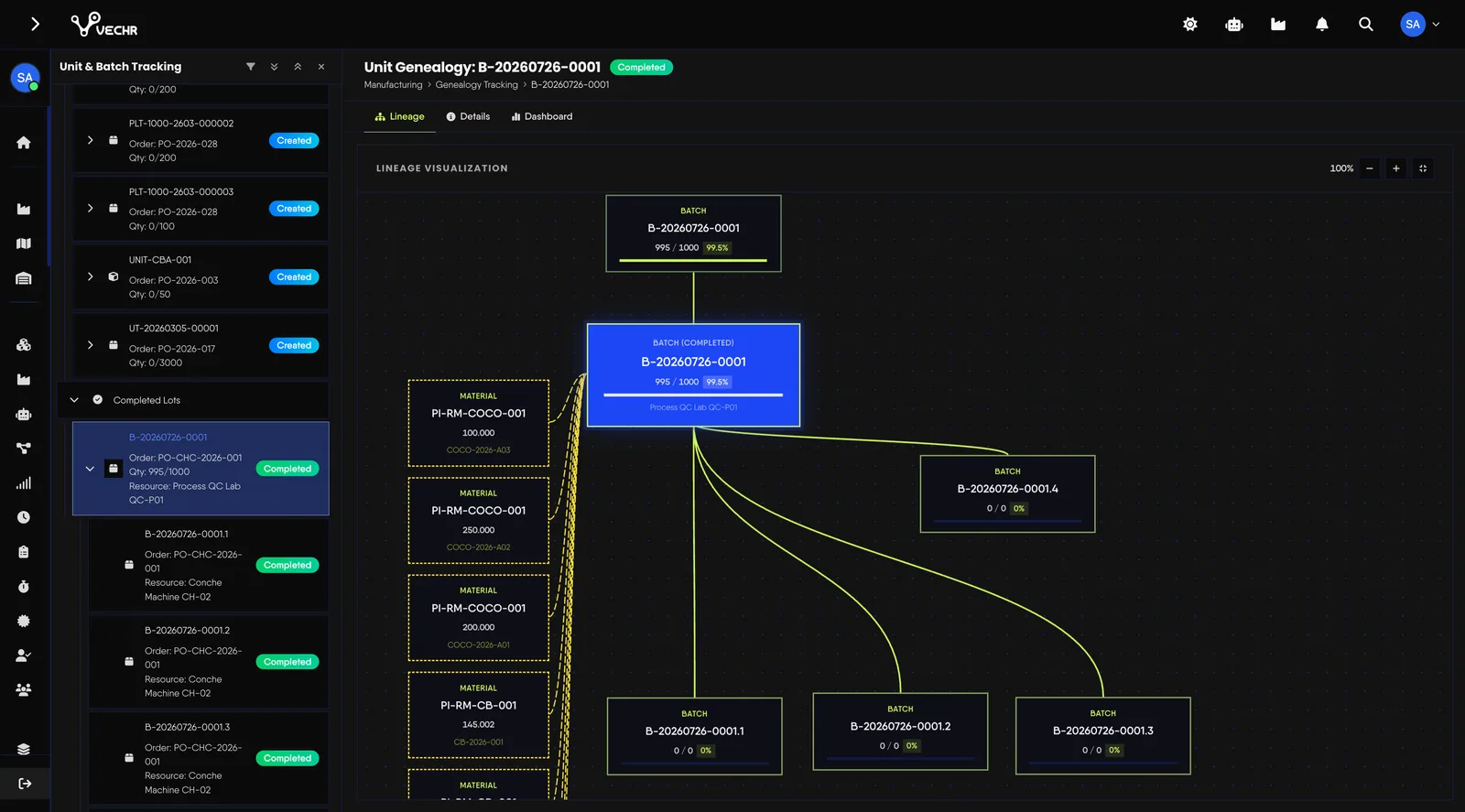
- Genealogy. Trace a finished lot back to every raw material used in it, or trace a given material forward to the products and customers affected, including through splits and merges.
- Attributable execution. Every production activity carries a clear timestamp and user identity. For processes that need tighter control, those activities can also carry an electronic signature.
- Continuously updated OEE. Availability, performance, and quality are computed from the equipment states that actually occurred, so there is no waiting until month end to gather and calculate them by hand.
In short: SCADA tells you what is happening at the machine. ERP tells you what was planned. MES connects the two with the context of the production process.
The most expensive mistake
The most common mistake is not choosing the wrong product. It is assuming the middle layer is not needed at all.
The ERP gets pushed into handling detail far too close to the shop floor. Or SCADA gets a reporting tool bolted on, then is expected to understand the context of orders, materials, and the production process.
In the end, the gap between them is filled manually. A whiteboard, a shift-handover spreadsheet, a group chat, or one person who happens to know the state of the whole plant by heart.
That can hold up while operations stay simple.
The problem appears as the scale grows: an audit arrives, a recall happens, a key person leaves, or a second plant starts up.
At that point, depending on information scattered across people and places becomes an operational risk.
Where VECHR MES sits
VECHR MES sits at Level 3 of the ISA-95 architecture, as the layer connecting business systems to the production process.
Upward, VECHR integrates with the ERP. Downward, it connects to SCADA, PLCs, and equipment over OPC UA, MQTT, and Modbus TCP.
The systems already running do not have to be replaced, as long as the equipment supports one of those protocols.
That positioning is deliberate. The ERP and the control systems on the floor are usually significant investments built up over years.
VECHR is not here to replace either of them. It fills the space in between, where the production plan meets reality on the shop floor.
Frequently Asked Questions
Can an ERP take over what an MES does?
Not entirely. ERP focuses on orders, planning, materials, and cost, while execution detail on the shop floor needs far more specific context. An ERP usually does not know which mixer a particular batch is in, what the tank temperature was at 02:40, or which operator completed the last step. Forcing all of that into the ERP normally means adding a lot of custom development that is hard to maintain and hard to extend.
Can SCADA take over what an MES does?
No. SCADA focuses on monitoring and controlling equipment in real time, but it does not carry the full business context behind that data. SCADA may know a tank temperature, but it does not necessarily know that the tank is being used for a particular production order or a particular material lot. Genealogy, electronic signatures, and order-level traceability belong to the MES layer.
Do we need ERP, MES, and SCADA all at once?
Not always. Each system has a different role, and every plant has different needs. But once operations require closer coordination between planning and production execution, the three are often used together. Smaller plants may run only ERP and SCADA, filling the middle with spreadsheets or manual workarounds. That is usually where an MES starts to earn its place.
What ISA-95 level is an MES?
Level 3, known in ISA-95 as Manufacturing Operations Management (MOM). ERP sits at Level 4, while SCADA and HMI are generally at Level 2. PLCs and DCS are at Level 1, and the physical process is Level 0.